
BLOG
Starting a Plumbing and Heating Business in the UK: What You Actually Need to Know
This guide is written from a UK perspective, but the underlying principles of starting a plumbing and heating business apply just as well in most English-speaking countries.
Introduction
Plumbing and heating remains one of the most reliably in-demand trades in the UK — boilers fail, pipes leak, and the shift toward heat pumps and low-carbon heating is creating an entirely new wave of retrofit work on top of everything else.
For a qualified plumbing and heating engineer, self-employment can mean genuinely strong earnings and control over your own working life.
But there’s a significant gap between being technically excellent at the trade and knowing how to build a profitable, compliant, sustainable business around it — and that gap is where most new business owners struggle.
This guide walks through what actually matters when you’re starting out: the qualifications and registration you need, how to structure the business, what compliance genuinely involves, how to price your work properly, and how to find and keep the customers who make the whole thing worthwhile.
Getting Qualified First, Self-Employed Second
Before any of the business questions matter, there’s a more basic one: are you actually ready? Self-employment in plumbing and heating isn’t something to rush into straight out of an apprenticeship. Most successful self-employed plumbing and heating engineers have spent real time on the tools first, building the kind of practical site experience that no qualification alone can give you — troubleshooting under time pressure, working in awkward spaces, and handling the unexpected problems that every real job throws up.
If you’re still building toward Level 2 or Level 3 qualifications, or want to strengthen the maths that underpins accurate pipework calculations, flow rates, and formula work, our Practical Maths for Plumbing & Heating course is built specifically around what plumbing and heating learners and apprentices actually need on site and in their vocational studies.
Understanding Gas Safe Registration — and What It Actually Covers
If any part of your work touches gas appliances, Gas Safe registration isn’t optional — it’s a legal requirement, and one of the most important compliance decisions you’ll make as you set up. Unlike some competent person schemes in other trades, which are largely voluntary routes to self-certifying work, Gas Safe registration is a legal necessity for anyone carrying out gas work, and working without it is a criminal offence.
It’s worth understanding clearly, before you register, exactly which categories of work you need to be assessed for. Boiler installation and servicing, central heating systems, and commercial or LPG gas work often fall under different registration categories, and getting registered for the wrong category — or assuming general plumbing competence covers gas work — is a common and costly mistake for people new to self-employment. The registration process itself involves choosing an ACS assessment centre, going through formal assessment, and then keeping your registration current through ongoing reassessment, so it’s not a one-off box to tick and forget.
Alongside Gas Safe registration, plumbing and heating engineers working on unvented hot water systems need the G3 qualification, and notifiable water regulations work needs to go through WaterSafe or your local water authority. None of this is optional detail — get it wrong, and you’re not just risking a fine, you’re risking your ability to trade at all.
Choosing the Right Business Structure
Once you’re confident you’re ready, the practical business decisions start: sole trader, limited company, or partnership. Each comes with different tax implications, different levels of personal liability, and different administrative overhead, and the right choice depends on your specific circumstances rather than a one-size-fits-all answer. Many plumbing and heating engineers start as sole traders for the simplicity, then move to a limited company structure later as turnover grows and the tax and liability trade-offs shift in favour of incorporation.
Whichever structure you choose, registering correctly with HMRC, opening a dedicated business bank account, and setting up basic record-keeping from day one saves enormous hassle later. It’s far easier to build good financial habits from your very first job than to try to untangle a year of mixed personal and business transactions at tax return time.
Insurance and Legal Protection
Public liability insurance is non-negotiable in this trade — a plumbing or heating job gone wrong can mean serious water damage, and without cover, that liability sits entirely on you. Professional indemnity insurance, tool insurance, and, if you ever take on staff, employers’ liability insurance all matter too, and it’s worth understanding exactly what each one covers before you assume you’re protected.
Data protection is another area new business owners often overlook entirely. If you’re holding customer names, addresses, and job details — which every plumbing and heating business does — basic data protection compliance applies to you too, even as a sole trader.
Building Your Tool Kit and Choosing a Van
Most plumbing and heating engineers already have a solid core hand tool kit by the time they go self-employed, but running a business changes the calculation. Test equipment — pressure and tightness testing kit, flue gas analysers, and the calibration certificates that go with them — becomes a genuine business cost and compliance requirement, not just a nice-to-have. Power tools and specialist equipment need the same careful cost-benefit thinking: buy too little and you’ll be turning down profitable work; buy too much too soon and you’ll be servicing debt on kit that sits unused.
Your van is arguably your biggest single tool. Getting the choice right — size, reliability, running costs, and how you fit it out — has a direct impact on how efficiently you can move between jobs and how professional you look turning up to a customer’s home. And once it’s stocked with several thousand pounds of tools, tool security and theft prevention stop being optional extras and become a real, ongoing part of running the business.
Pricing: The Part Most New Business Owners Get Wrong
Undercharging is the single most common reason technically excellent tradespeople struggle financially when they go self-employed. It’s not usually a lack of skill — it’s a failure to properly understand true business costs (van running costs, insurance, tool replacement, non-billable admin time, holiday and sick pay you no longer get automatically) and translate that into an hourly rate that actually covers them, with a genuine profit margin on top.
Quoting and estimating jobs accurately, and then holding your ground when a customer pushes back on price, is a skill in itself — one that’s just as important as anything you learned during your technical training. Plumbing and heating work also comes with a particular pricing challenge that many trades don’t face in the same way: a large proportion of work is emergency call-out, where customers are stressed, comparing you against competitors quickly, and sometimes pushing hard for a lower price at the worst possible moment to negotiate calmly. Getting comfortable pricing that work fairly — for both you and the customer — takes deliberate practice.
Where Your Customers Actually Come From
New plumbing and heating businesses often assume marketing means advertising, when in reality, a huge proportion of sustainable trade work comes from relationships: builders who need a reliable plumbing and heating engineer for every job, landlords and letting agents who want one number to call for every property they manage, and existing customers who refer you to friends and family after a job well done.
Building those relationships takes time and consistency, but it pays back far more reliably than one-off advertising spend. Turning enquiries into actually booked jobs — responding quickly, quoting clearly, and making it easy for a customer to say yes — matters just as much as generating the enquiry in the first place, and it’s a step many new businesses lose more work at than they realise.
For a much deeper dive into marketing your plumbing and heating business specifically — social media, local visibility, and building the kind of reputation that generates consistent referral work — our marketing and social media resources cover this in far more detail than any single blog post can.
Delivering the Work Properly
Winning the job is only half the equation. Working cleanly and professionally on site — protecting a customer’s home, tidying up properly, communicating clearly about what you’ve found and what you’re doing — is what turns a one-off job into a returning customer and a five-star review. Getting testing, certification, and sign-off right every single time isn’t just good practice, it’s what protects you legally and professionally if anything is ever questioned later.
Health and safety runs through all of this too — recognising and controlling common hazards, having the right PPE, and following safe systems of work aren’t bureaucratic box-ticking, they’re what keeps you working, uninjured, for the length of a genuinely long career in a physically demanding trade.
Running the Business Day to Day
Once the work is flowing, the challenge shifts to managing it well: your time, your cash flow, your tax position, and the inevitable complaints and comebacks that every business, however good, occasionally faces. Keeping your skills current as the industry changes — and it’s changing fast, with the shift toward heat pumps and low-carbon heating creating both new opportunities and new training demands — is an ongoing commitment, not a one-off qualification.
Many plumbing and heating engineers also reach a point where public sector and commercial contract work becomes genuinely worth pursuing — housing association maintenance contracts, local authority compliance testing programmes, and similar recurring work that offers far more predictable income than relying purely on individual domestic call-outs. If that’s a direction you’re considering, our complete guide to winning tenders covers exactly how plumbing, gas, and heating contractors can find, bid for, and win exactly this kind of work.
Growing Beyond a One-Person Operation
At some point, many plumbing and heating business owners face a genuine decision: stay a highly profitable one-person operation, or grow. Growth brings its own set of decisions — taking on subcontractors for overflow work, bringing on an apprentice, or eventually employing staff directly — and each comes with real trade-offs in control, cost, and complexity that are worth thinking through carefully rather than drifting into.
Building systems that let the business run without you personally doing every single job is what eventually makes stepping back from the tools possible, whether that means taking a step back to manage rather than deliver, or eventually planning a genuine exit from the business altogether.
The Bigger Picture
A career in plumbing and heating, done well, isn’t just a series of jobs — it’s a genuinely long-term career that rewards people who take the business side as seriously as the technical side. That means looking after your body over decades of physically demanding work, planning realistically for your eventual exit rather than leaving it as an afterthought, and staying alert to industry change rather than being caught out by it.
None of this is covered in a plumbing or Gas Safe qualification, and that’s exactly the gap that causes so many technically brilliant plumbing and heating engineers to struggle financially or burn out running a business they were never taught how to run. Getting the business fundamentals right from the start — pricing, compliance, marketing, and systems — makes the difference between a stressful, unpredictable trade and a genuinely profitable, sustainable career.
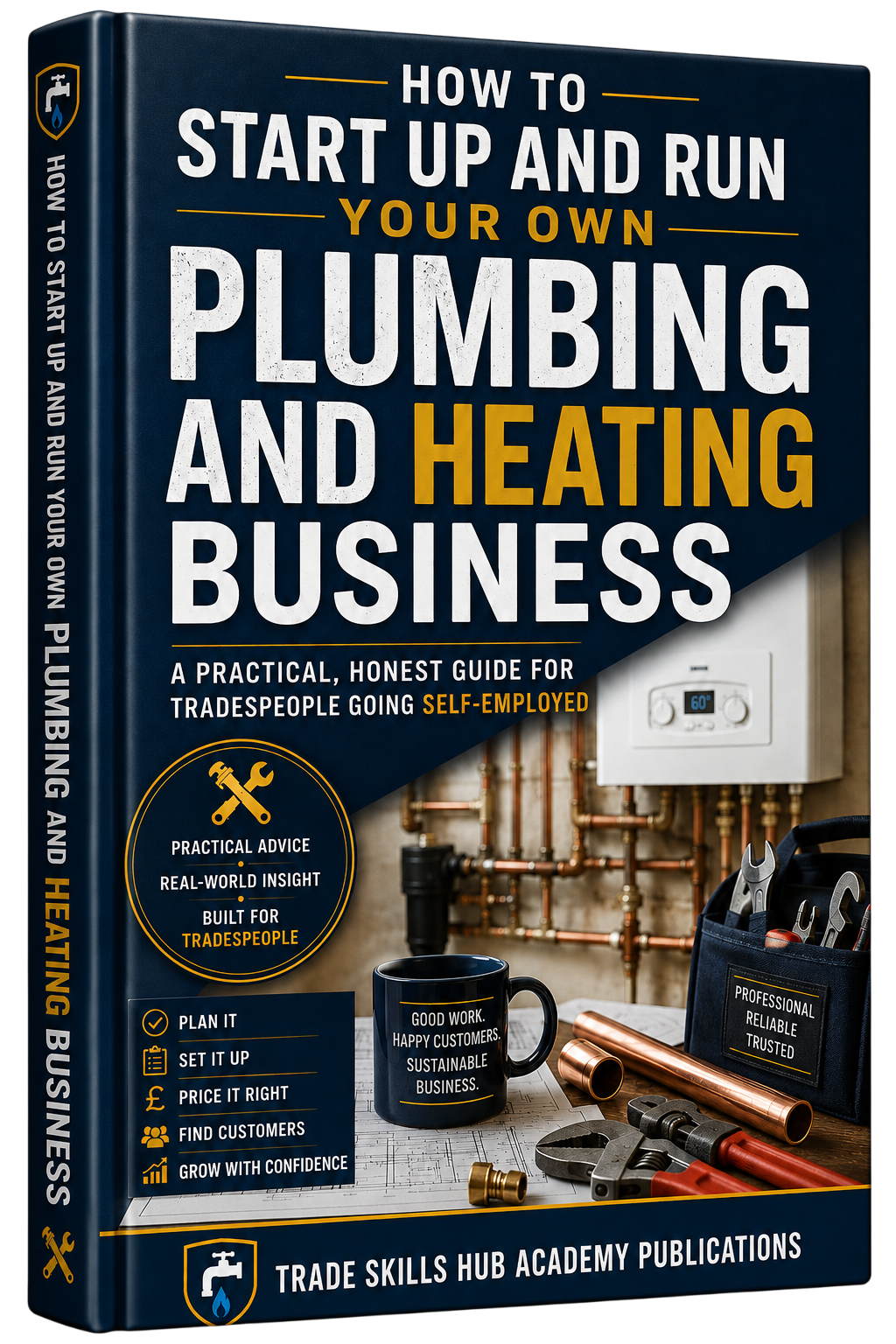
For a complete, chapter-by-chapter walkthrough of everything covered here — plus worked examples, a full self-employment readiness self-assessment, a sample terms and conditions template, and a chapter-by-chapter checklist to work through as you build your business — How to Start Up and Run Your Own Plumbing and Heating Business takes you through the entire journey in far more depth than any blog post can.
About Trade Skills Hub Academy
Trade Skills Hub Academy publishes practical, plain-English guides for tradespeople who want to start, run, and grow a genuinely profitable business — not just learn a trade. Alongside plumbing and heating, you’ll find dedicated guides across our full range of trade business start-up guides, plus practical maths courses, marketing resources, and a complete guide to winning tenders for tradespeople ready to move into public sector and commercial contract work.
Explore the full range of guides at www.tradeskillshubacademy.com