
Running a Profitable Trade Business
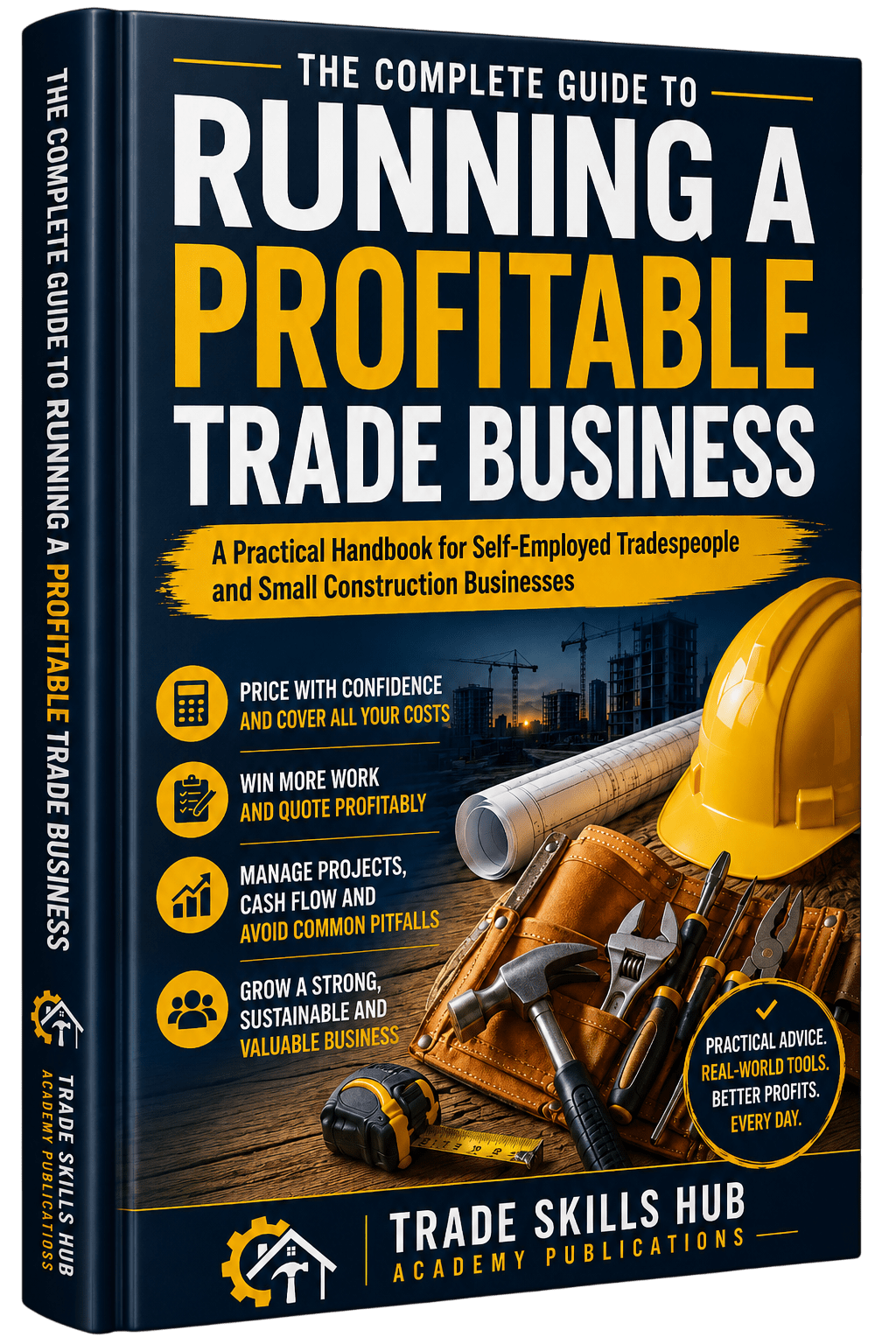
The Complete Guide to Running a Profitable Trade Business
Stop being busy. Start being profitable.
The practical guide to pricing your work correctly, controlling costs, winning profitable jobs and building a trade business that actually pays you.
Being good at your trade doesn’t automatically make you good at running a trade business.
You might be an excellent electrician, plumber, builder, decorator, carpenter, handyman or other tradesperson. You may have plenty of work and a diary that’s full for weeks ahead.
But do you know exactly how much profit you’re making from each job?
Do you know what your true hourly cost is?
Are you charging enough to cover your overheads, vehicle costs, non-chargeable time and the income you need?
Do you know whether your business could afford to employ someone?
And when you finish a busy month, do you know where all the money has gone?
The Complete Guide to Running a Profitable Trade Business has been written to help you answer those questions — and take control of the business behind your trade.
Your trade skills make you the money. Your business skills keep it.
Most tradespeople learn how to do their trade.
They don’t necessarily learn how to run a profitable business.
That’s where problems can start.
A tradesperson can spend years building a reputation, attracting customers and becoming increasingly busy, while unknowingly undercharging for their work.
The result?
More work can actually mean more stress without a corresponding increase in profit.
This book takes a different approach.
Rather than simply telling you to “charge more” or “get more customers”, it takes you through the practical business decisions that determine whether a trade business is genuinely profitable.
It starts with your costs and works through pricing, estimating, quotations, winning work, project management, cash flow, growth and technology.
The result is a practical roadmap for building a better-run trade business.
What will you learn?
Understand the true cost of running your business
Before you can work out what to charge, you need to understand what the business actually costs you.
The book looks at the costs that are easy to see — and those that are often overlooked.
That includes:
- Business overheads
- Vehicle costs
- Labour costs
- Tools and equipment
- Insurance
- Administration
- Travelling
- Quoting
- Training
- Holidays and non-chargeable time
Understanding these costs provides the foundation for everything that follows.
Calculate a charge-out rate based on reality — not guesswork
How did you decide what to charge?
If your answer is “that’s about what other tradespeople charge”, you’re not alone.
But another tradesperson’s costs aren’t necessarily the same as yours.
The book shows you how to approach your charge-out rate from the bottom up, using your actual costs and genuinely chargeable hours rather than simply assuming that every hour you’re available can be billed.
The objective is simple:
Know what your business needs to charge to cover its costs and generate a worthwhile profit.
Price materials properly
Materials can represent a substantial part of a job.
But are you making anything from supplying them?
The book explains material pricing and mark-ups and looks at why simply passing materials on to the customer at cost can leave potential profit behind.
You’ll learn how to approach material pricing as part of your overall business model rather than treating it as an afterthought.
Produce better estimates
Getting an estimate wrong can be expensive. Underestimate the labour and you may lose money. Forget materials and you may have to absorb the cost. Fail to allow for waste, travelling or difficult working conditions and your expected margin can disappear. The book provides a structured approach to estimating labour and materials, helping you move away from relying entirely on memory and instinct.
Write quotations that protect your business
A quotation is more than a price. It should tell your customer what they are actually agreeing to.
The book looks at the practical elements of producing professional quotations, including:
- Scope of work
- Labour
- Materials
- Exclusions
- Assumptions
- Payment terms
- Timescales
- Variations
The objective is to reduce misunderstandings while presenting your business professionally.
Learn how to win more profitable work
Getting more enquiries isn’t necessarily the answer.
You want the right enquiries.
The book looks at different routes to winning work, including domestic customers, commercial opportunities and tendering.
You’ll also learn why you shouldn’t automatically pursue every opportunity that comes along.
Sometimes the most profitable decision is deciding not to bid for a job.
Manage jobs so your profit doesn't disappear
Winning a job at the right price is only half the battle.
You then have to deliver it at the cost and timescale you allowed for.
Poor planning can result in:
- Lost working time
- Material shortages
- Delays
- Unnecessary travelling
- Poor sequencing
- Additional costs
- Disputes with customers
The book looks at practical job planning and project management so that the profit you built into your quotation has a better chance of remaining profit when the job is finished.
Understand cash flow, profit and tax
A profitable business can still experience cash-flow problems.
You may have completed work and sent invoices, but if customers haven’t paid, the money isn’t available to pay your suppliers and other expenses.
The book therefore looks at the financial side of running a trade business, including:
Cash flow | Profit and loss | Record keeping | Tax
Understanding the numbers gives you much greater control over the business.
Thinking about taking on employees?
Growth can be exciting.
But employing someone is a major step for a small trade business.
The book looks at the financial and practical considerations involved in increasing your capacity, including the difference between employees, apprentices and subcontractors.
You’ll also consider whether you actually have enough consistent work to keep another person productively occupied.
More people doesn’t automatically mean more profit.
Growth needs to be planned.
Build systems that make your business easier to run
As your business grows, relying on memory becomes increasingly risky.
That’s why the book includes practical tools designed to help turn good business practices into repeatable systems.
These include:
- Templates
- Worksheets
- Estimating tools
- Checklists
- Job-planning resources
- Business review tools
The idea is simple:
Don’t just learn what you should do. Create a system that helps you actually do it.
Discover how technology and AI can help
Technology is changing the way small businesses operate.
The book explores practical uses of technology for tradespeople, including:
- Accounting
- Quoting
- Invoicing
- Scheduling
- Customer management
- Job records
- Business administration
It also introduces the practical use of AI for tradespeople.
AI can help with tasks such as drafting customer communications, preparing first drafts of quotations and marketing material, organising information and creating job plans.
But the book also explains where caution is required and why AI-generated technical, legal and regulatory information should never simply be accepted without checking.
A practical roadmap — not a business theory book
The book is deliberately structured so that the different parts of running a trade business build upon each other.
Part 1 — Business Foundations
Understand the challenges of running a trade business and establish the foundations for your own.
Part 2 — Understanding Your Costs
Identify the real costs of running the business, including the costs that are easily overlooked.
Part 3 — Your Charge-Out Rate
Turn your costs and genuinely chargeable hours into a realistic charge-out rate.
Parts 4 & 5 — Estimating and Materials
Estimate labour accurately and price materials properly.
Part 6 — Professional Quotations
Turn your calculations into quotations that clearly communicate what you’re offering.
Part 7 — Winning Work
Explore domestic, commercial and tender opportunities.
Part 8 — Managing Projects
Plan and manage jobs so that your carefully calculated profit isn’t lost during delivery.
Part 9 — Managing the Money
Understand cash flow, profit and loss, record keeping and tax.
Part 10 — Growing the Business
Look at marketing, employing staff and developing better systems.
Part 11 — Technology and AI
Discover how modern technology can reduce administration and help you run the business more efficiently.
Part 12 — Your Practical Toolkit
Bring everything together with templates, worksheets and checklists.
The book deliberately follows this progression because marketing and growth should come after the financial foundations have been established. As the book explains, bringing in more work that has been priced below its true cost simply creates a busier, less profitable business.
Who is this book for?
✔ Tradespeople thinking about becoming self-employed
If you’re considering leaving employment and starting your own trade business, this book can help you understand the business side before you take the plunge.
✔ Newly self-employed tradespeople
If you’ve been trading for a year or two but still aren’t certain whether you’re charging enough or making the profit you expected, the book gives you a structured way to review the business.
✔ Established sole traders
Even an established business can benefit from reviewing its costs, pricing, cash flow and systems.
✔ Small trade businesses looking to grow
If you’re considering employing staff, taking on larger contracts or moving into commercial work, the book provides a framework for thinking about the financial and operational implications.
Your business doesn't have to be complicated
You don’t need a huge office. You don’t need a large workforce. You don’t need complicated business jargon. But you do need to understand the numbers. A profitable trade business is built on relatively straightforward principles:
Know your costs.
Calculate your rate.
Price your work properly.
Control your materials.
Quote professionally.
Manage variations.
Plan your jobs.
Control your cash flow.
Market the business.
Use systems.
Review your performance.
And if you decide to grow, make sure the numbers work before you do it.
Downloadable Resources
| No. | Resource | Chapter |
|---|---|---|
| Worksheets and Templates (22) | ||
| 1 | Chapter 1 Reflection Worksheet | Ch 1 |
| 2 | Turnover vs Profit Worksheet | Ch 2 |
| 3 | Short, Medium and Long-Term Goals Template | Ch 3 |
| 4 | Business Overhead Worksheet | Ch 4 |
| 5 | Vehicle Running Cost Table | Ch 5 |
| 6 | Fully Loaded Labour Cost Worksheet | Ch 6 |
| 7 | Task Breakdown Template | Ch 10 |
| 8 | Time Recording Sheet | Ch 10 |
| 9 | Labour Adjustment Factors Worksheet | Ch 11 |
| 10 | Special Order Items Policy Template | Ch 14 |
| 11 | Consumables and Waste Allowance Worksheet | Ch 15 |
| 12 | Material Waste Allowance Table | Ch 15 |
| 13 | Professional Quotation Template | Ch 16 |
| 14 | Sample Terms and Conditions Template | Ch 17 |
| 15 | Generic RAMS Template for Commercial Jobs | Ch 20 |
| 16 | Commercial Quotation Template | Ch 20 |
| 17 | Variation Pricing Worksheet | Ch 23 |
| 18 | Itemised Invoice Template | Ch 23 |
| 19 | Job Record-Keeping Template | Ch 24 |
| 20 | Overdue Invoice Chasing Sequence | Ch 25 |
| 21 | Review & Referral Request Templates | Ch 28 |
| 22 | Master Template Review Schedule | Ch 33 |
| Checklists (19) | ||
| 23 | Business Owner Mindset Checklist | Ch 2 |
| 24 | Charge-Out Rate Readiness Checklist | Ch 7 |
| 25 | Site Visit Assessment Checklist | Ch 11 |
| 26 | Material Price Check Checklist | Ch 13 |
| 27 | Quotation Checklist | Ch 16 |
| 28 | Home Visit Checklist | Ch 19 |
| 29 | Tender Compliance Document Checklist | Ch 21 |
| 30 | Daily Progress Checklist | Ch 22 |
| 31 | Monthly P&L Review Checklist | Ch 26 |
| 32 | Allowable Expenses Checklist for Tradespeople | Ch 27 |
| 33 | Questions to Ask Your Accountant Checklist | Ch 27 |
| 34 | Online Presence Consistency Checklist | Ch 28 |
| 35 | New Starter Induction Checklist | Ch 29 |
| 36 | System Review & Refinement Checklist | Ch 30 |
| 37 | Monthly Business Review Routine Checklist | Ch 31 |
| 38 | What to Check Before Sending AI-Drafted Content | Ch 32 |
| 39 | Template Personalisation Checklist | Ch 33 |
| 40 | Checklist Review & Refinement Schedule | Ch 35 |
| 41 | New Staff Checklist Training Pack | Ch 35 |
| Calculators (7) | ||
| 42 | Personal Income Goal Calculator | Ch 3 |
| 43 | Labour Burden Calculator | Ch 6 |
| 44 | Chargeable Hours Calculator | Ch 8 |
| 45 | Charge-Out Rate Calculator | Ch 9 |
| 46 | Material Mark-Up Calculator | Ch 14 |
| 47 | Tax & VAT Set-Aside Calculator | Ch 25 & 27 |
| 48 | Gross vs Net Margin Calculator | Ch 26 |
| Trackers and Logs (5) | ||
| 49 | Personal Labour Database Template | Ch 12 |
| 50 | Supplier and Trade Account Tracker | Ch 13 |
| 51 | Material Ordering & Lead-Time Tracker | Ch 22 |
| 52 | Labour Database Time-per-Unit Tracker | Ch 34 |
| 53 | Estimate vs Actual Comparison Log | Ch 34 |
| Scripts and Message Templates (4) | ||
| 54 | Value Reminder Script Template | Ch 18 |
| 55 | Post-Job Review Request Text/Email Template | Ch 19 & 28 |
| 56 | Complaint Response Script and Escalation Routes | Ch 24 |
| 57 | Customer Communication Message Templates | Ch 30 |
| Reference Sheets (3) | ||
| 58 | Business Success Roadmap | Ch 1 |
| 59 | Masterclass-to-Chapter Reference Guide | Ch 31 |
| 60 | Information You Should Never Share With AI Tools | Ch 32 |
| Forms (1) | ||
| 61 | Variation Agreement Form | Ch 17 & 23 |
| Decision Guides (1) | ||
| 62 | Employee vs Apprentice vs Subcontractor Decision Guide | Ch 29 |
Stop guessing. Start running your business by the numbers.
Your trade skills are what allow you to earn money. But your business systems determine how much of that money you actually keep. The Complete Guide to Running a Profitable Trade Business brings the two together. It’s a practical handbook designed to help tradespeople move from simply working for themselves to actually running a profitable business.
Get your copy today
The Complete Guide to Running a Profitable Trade Business
Practical business guidance for tradespeople who want to understand their costs, price their work properly, win profitable jobs and build a sustainable business.
Also available from Trade Skills Hub Academy
[Trade Profit App] — calculate your costs, charge-out rate and job profitability.
[Trade Business Start-Up Guides] — practical guides for people looking to start and run their own businesses.
[How to Market Your Trade Business] — learn how to attract more customers using websites, SEO, Google Business Profile, social media, reviews and other marketing methods.
[Winning Work: The Tradesman’s Complete Guide to Tendering] — learn how to identify, prepare for and bid for larger work opportunities.
One final thought
A trade business shouldn’t simply give you a full diary. It should give you a worthwhile return for your skill, time, investment and risk. That’s the difference between being self-employed and building a profitable trade business. The Complete Guide to Running a Profitable Trade Business is designed to help you make that transition.