
Winning Work – Guide to Tendering
A Complete Step-by-Step Guide to Winning Public & Private Sector Contracts as a Trade Contractor in the UK
Ready to win your first public or private sector contract — or make the bids you’re submitting more likely to succeed?
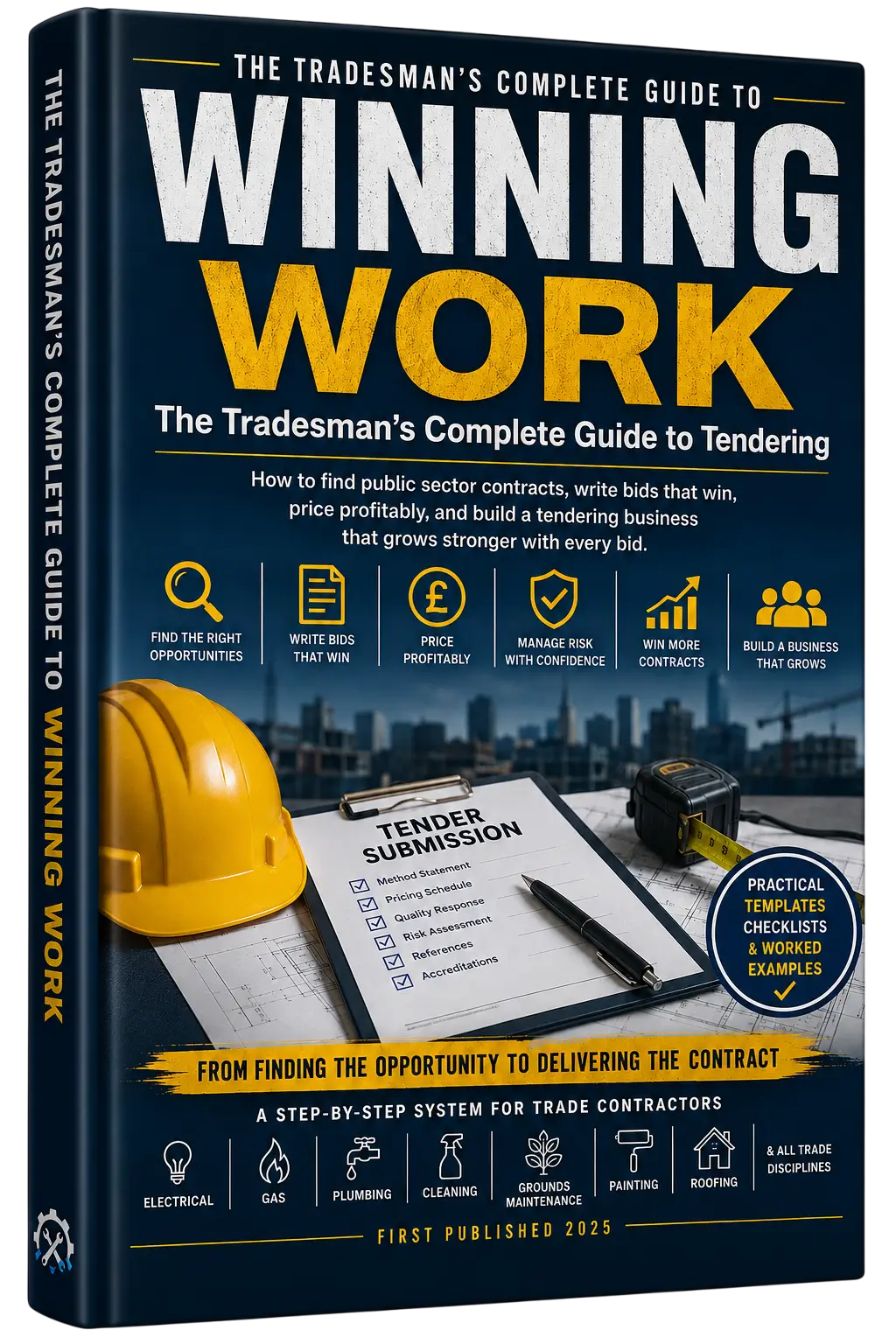
Winning Work: The Tradesman’s Complete Guide to Tendering is a comprehensive, practical guide written for trade and maintenance contractors who want to find, bid for, and win public sector contracts in the UK, from the electrician who has never seen an ITT to the established operator who has submitted bids but cannot understand why they keep losing.
The book covers every stage of the tendering journey: finding the right opportunities, making your business compliant and tender ready, reading and understanding tender documents, writing method statements and quality responses that score maximum marks, pricing contracts accurately and profitably, producing risk assessments and RAMS, and building the systems that make every future bid faster and more competitive than the last. Contractors can also strengthen their wider business approach with the How to Market Your Trade Business guide, which covers marketing foundations, lead generation, websites, SEO, reviews, and other ways to attract work.
It covers the full range of trade disciplines, electrical, gas, plumbing, cleaning, grounds maintenance, painting, roofing, and all maintenance contractor types, and the full range of public sector buyers: housing associations, local authorities, NHS trusts, government departments, and other contracting authorities. Whether you are targeting a single housing association contract worth £100,000 or building toward multiple framework agreements, the principles, tools, and worked examples in this book apply directly to your situation.
Across 29 chapters and more than 400 pages, the book combines clear explanations of how public sector procurement works with practical, immediately usable tools, including worksheets, cost model templates, model quality responses, RAMS templates, and action plans, that you can put to work on your next bid. For contractors focused on improving pricing and profitability alongside tendering, the Trade Profit App also supports better understanding of true costs, charge out rates, and job profitability.
What You’ll Learn
- How public sector tendering works — from contract notice to award, and what buyers are actually looking for
- How to assess whether your business is ready to tender, and how to close the gaps if it is not
- The insurance levels, accreditations, and policies that public sector buyers require as a minimum
- How to build an evidence bank of case studies, performance data, photographs, and references that earns quality marks
- Where public sector contracts are published — the portals, how to register, and how to set up alerts
- How to get onto approved contractor lists that generate work without formal tendering
- The fast first filter: how to assess a new opportunity in five minutes and decide whether to bid
- How to read a tender pack in the correct order — ITT, specification, contract conditions, TUPE schedule, pricing schedule — and what to look for in each
- How evaluation scoring works, what each score level requires, and how to reverse-engineer the criteria into a winning response structure
- How to plan a bid: the reading and planning session, the Response Plan, the timetable, and the compliance check
- How to write method statements that score 5/5 — with a complete worked example for an electrical testing contract and trade-specific guidance for six trades
- Model answers for the eight most common quality question categories, with scoring commentary
- How to use case studies, photographs, and references as integrated evidence rather than compliance attachments
- How to build a bottom-up cost model covering labour at true employer cost, materials, vehicles, subcontractors, overheads, and profit
- The ten pricing traps that produce either a non-competitive price or a loss-making contract — and how to avoid every one
- The legal framework for risk assessments and RAMS — with five complete worked examples across different trades
- How to submit, handle post-submission queries, and prepare for a tender interview
- What to do when you win: TUPE consultation, mobilisation, first thirty days, and year-one delivery
- The ten most common reasons tenders fail — and how to use feedback to improve your next submission
- How to build a tender library and a tendering system that compounds your advantage over every bid that follows
Includes 28 Practical Tools
Throughout the book, and collected in the back matter reference section, Winning Work contains 28 ready-to-use templates, checklists, worksheets, and action plans:
- Tender Readiness Assessment — a structured self-assessment covering structures, credentials, policies, evidence, and pricing capability
- Seven policy templates — Health and Safety, Environmental, Quality, Equality and Diversity, Anti-Bribery, Complaints, and GDPR
- Evidence Bank Index — a master register of all case studies, performance data, photographs, and references
- Fast First Filter — a five-question rapid assessment for new opportunities
- Opportunity Assessment Worksheet — a ten-criterion scoring tool for the bid/no-bid decision
- Tender Planning Worksheet — a six-section planning document covering basic information, key dates, evaluation criteria, compliance, responsibilities, and bid decision
- Response Plan — a question-by-question tracker showing word limits, weightings, evidence needed, owner, and status
- Bid Timetable Template — a day-by-day schedule from tender receipt to submission
- Pre-Submission Compliance Checklist — confirming every required document and declaration is complete
- Method Statement Structure and Review Checklist — nine-section anatomy with an eleven-point review gate
- Quality Response Library (eight base responses) — model answers for the most common quality question categories
- Case Study Template (STAR format) — with reference contact entry format
- Cost Model Template — six-section build-up covering all cost elements
- Schedule of Rates Template — with labour rates by time period, planned maintenance rates, and materials uplift
- Margin Sensitivity Test — a four-scenario financial test before submission
- Pre-Submission Pricing Review — a twelve-item checklist covering all pricing trap avoidance measures
- Risk Assessment Form — seven-column hazard register with worked example
- RAMS Document Template — eight-section integrated risk assessment and method statement
- RAMS Library Index — a master register of all RAMS documents with review schedule
- Feedback Log — a bid-by-bid record of scores, feedback received, and actions taken
- Win Rate Tracker — annual tracking of bids submitted, won, and revenue secured from tendering
- Tender Library Index — a master register of all library documents with version and review dates
- Weekly Tendering Routine — a structured weekly calendar of tender management activities
- Monthly Review Agenda — a sixty-minute structured agenda for monthly performance review
- Tendering Performance Dashboard — six key metrics for measuring and improving bidding performance
- 90-Day Tender Success Plan — a week-by-week, thirteen-week roadmap to the first submitted bid
Ideal For
This book is suitable for:
- Trade contractors who have never submitted a tender and want a complete, practical guide to getting started
- Contractors who have submitted bids but not won consistently, and want to understand specifically what is suppressing their scores
- Electricians, gas engineers, plumbers, heating engineers, and other mechanical and electrical contractors targeting housing association and local authority compliance contracts
- Cleaning, grounds maintenance, painting, and general maintenance contractors pursuing public sector service contracts
- Sole traders and small businesses looking to move beyond word-of-mouth and referrals into sustainable, recurring public sector revenue
- Businesses preparing to bid for approved contractor lists, frameworks, or dynamic purchasing systems for the first time
- Operators who have received poor feedback on previous bids and want to understand what to change
- Business owners who want to build the long-term tendering systems — library, routines, metrics — that make bidding progressively more efficient and more successful
Why Choose This Guide?
Most tendering guides are written for large organisations — procurement departments, framework contractors, bid management teams with dedicated resource. They assume an infrastructure that most small trade contractors do not have and do not need.
Winning Work was written for the business owner who needs to write a bid alongside running a business, managing operatives, and delivering existing contracts. Every tool is sized for one person working to a deadline. Every example reflects the real contracts small trade contractors actually bid for — maintenance frameworks, compliance testing programmes, cleaning contracts, responsive repair services. Not multi-million pound construction projects. Not central government IT procurement. The work your business actually does.
The book goes further than the method statement and the pricing schedule. Part 8 follows a fictional electrical contractor — Bright Spark Electrical Services Ltd — through every stage of a complete bid for a housing association contract: discovering the opportunity, reading the documents, finding the TUPE obligation buried in the schedule, building the cost model around the transferring employees’ actual salaries, writing all six quality sections, attending the interview, winning the contract, mobilising the team, and delivering the first year above every KPI target. It is the most detailed worked example of a public sector bid process available for trade contractors.
The book is direct and honest. It does not promise that winning public sector contracts is easy, or that every bid will succeed. It shows you, clearly and specifically, what the contractors who win consistently do differently from those who do not — and it gives you the tools, frameworks, and habits to build those practices from your next bid forward.
Written in plain English and grounded in real procurement practice, it provides a complete roadmap for any trade contractor who wants to bid confidently, price accurately, and build a public sector revenue stream that grows stronger with every contract won.
Find the right contracts. Write responses that earn full marks. Price work that stays profitable. Build a tendering business that compounds over time.