
Estimating for Tradespeople
The complete method for pricing trade work from real labour times, real material costs and real risk — plus the tools to build a labour-time database from your own jobs.
52 chapters · 15 fully worked estimates · 467 scoped tasks across 15 trades · free companion database
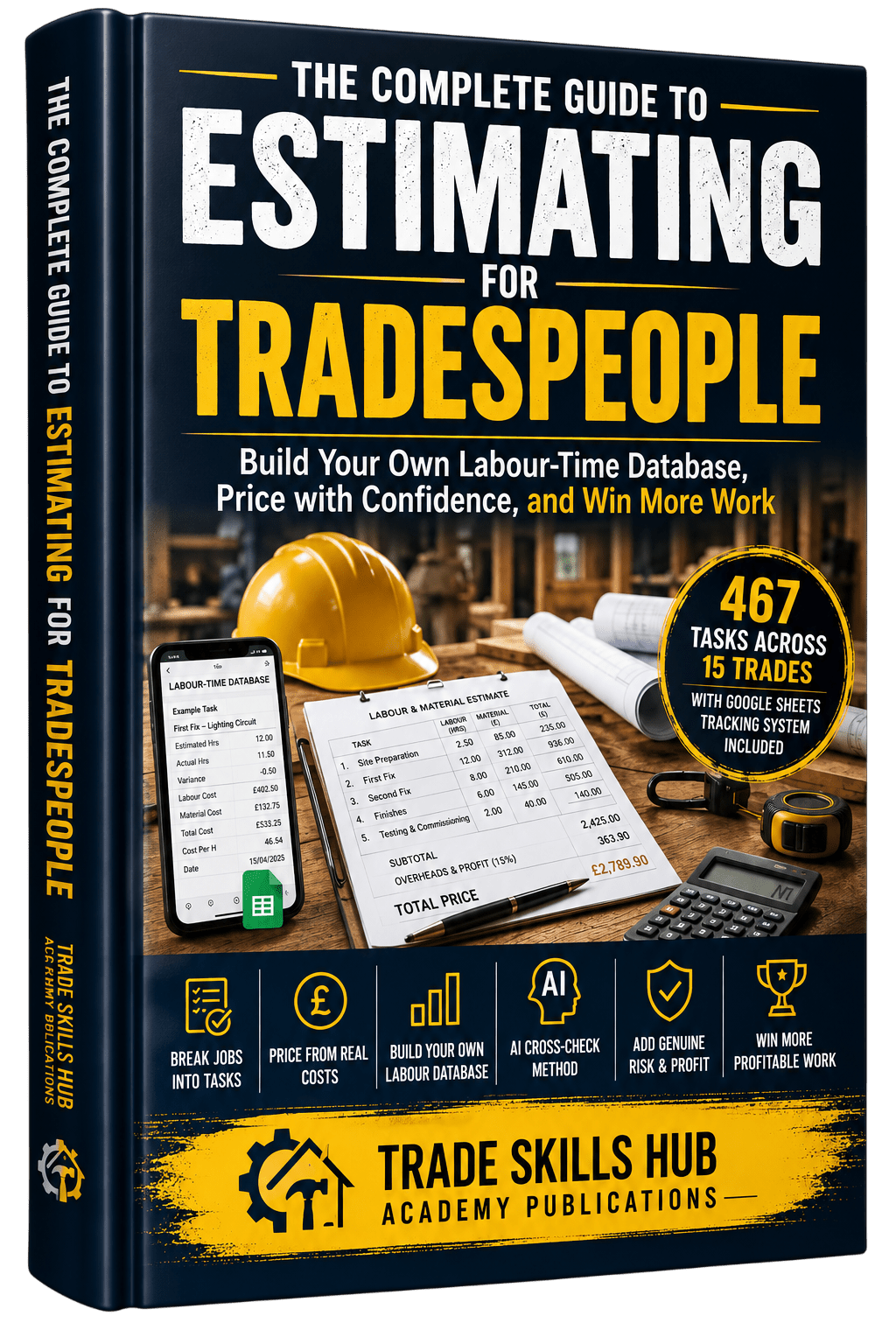
Most tradespeople price the same way: a figure forms in your head, built from years of doing the work, adjusted for how the job feels on the day.
It works, right up until it doesn’t. A job runs three days long. A margin turns out thinner than you thought. A competitor quotes a number that makes no sense against the same scope, and you have no way of telling whether they are wrong or you are.
The problem is not your experience. Experience is exactly what makes a good estimator. The problem is that experience kept in your head cannot be checked, cannot be handed to anyone else, and cannot be improved on deliberately.
A gut-feel price cannot be interrogated. A task-by-task, cost-built price can. This book teaches you to build one.
Published pricing guides have two problems. They go stale the moment they are printed, and the figures inside them are averages of other people’s businesses — businesses with different crews, different suppliers, different access and a different standard of finish.
This book does not hand you a fixed table of numbers to copy. It teaches you a method for arriving at a defensible figure for any task, and gives you the tools to turn your own completed jobs into a database that gets more accurate every time you use it.
A figure drawn from ten of your own jobs beats an industry average every time, because it is not an average at all. It is your own reality.
Inside the Book
Why estimating goes wrong and how to get the fundamentals right: estimating versus costing, pricing and quoting; breaking a job into measurable tasks; labour hours versus elapsed time; employer on-costs and recoverable hours; how to calculate an honest hourly charge-out rate; material take-offs, waste and pack sizes; mark-up versus margin; overheads; and how to put a genuine, statable number on risk.
One job, priced from first contact to final quotation. A full bathroom refurbishment broken into 43 tasks: the site survey, the scope of work, the labour estimate, the material take-off, subcontractors, contingency, the gross profit check, the quotation and the staged payment schedule — then the estimate-against-actual record that feeds the whole thing back into your database.
Fifteen trades, each with its own chapter of scoped task categories and labour-time bands: electrical, plumbing and heating, carpentry and joinery, painting and decorating, plastering and drylining, brickwork and masonry, roofing, tiling, flooring, groundworks and landscaping, kitchen fitting, bathroom fitting, general building, window and door installation, and insulation.
Every one built the same way, start to finish, with the reasoning stated at every step — including why the contingency rate is what it is on that particular job:
- Replace a consumer unit · install additional sockets · three-bedroom house rewire
- Plaster a room · tile a bathroom · install laminate flooring · decorate a three-bedroom house
- Replace radiators · replace internal doors · repair a roof
- Construct a garden wall · install fencing · lay a patio
- Bathroom refurbishment · kitchen installation · full property refurbishment (multi-trade, with subcontractor packages)
Presenting the quotation, handling price objections without cutting your margin, following up and learning from the jobs you lose, and turning an accepted estimate into a live job that actually runs to plan.
Appendices A–N
Working templates, not filler: blank task breakdown, charge-out rate calculator, material take-off template, mark-up versus margin quick reference, overheads worksheet, risk and contingency rate guide, task library summary, trade quick-reference index, blank quotation, follow-up and loss-reason templates, estimate-versus-actual record, glossary, staged payment schedules, and the full database setup guide.
The Free Companion Database
Every copy comes with a ready-made task library and job log, built in a free form-and-spreadsheet system so there is no software to buy and no subscription to run.
467 individually scoped tasks across fifteen trades, from a single socket outlet to a full property rewire. You make your own private copy in your own account, log a job in under a minute, and every entry lands in your own spreadsheet as a row in your own labour-time database.
| Trade | Task categories |
|---|---|
| Electrical | 12 |
| Plumbing & Heating | 15 |
| Carpentry & Joinery | 12 |
| Painting & Decorating | 8 |
| Plastering & Drylining | 7 |
| Brickwork & Masonry | 8 |
| Roofing | 10 |
| Tiling | 9 |
| Flooring | 7 |
| Groundworks & Landscaping | 11 |
| Kitchen Fitting | 10 |
| Bathroom Fitting | 9 |
| General Building / Handyman | 7 |
| Window & Door Installation | 6 |
| Insulation | 9 |
It is yours, privately. Nobody else can see your data — not other readers, not us.
Where AI Fits, and Where It Doesn’t
On day one you have no data of your own, and you still have to quote something. That is the one job AI does well here.
The book teaches a five-step cross-check: define the task precisely, get a drafted range with its reasoning and sources shown, check whether those sources are actually any good, test the range against your own judgement, then record what the job really took.
The book is honest about what that turns up. In the worked example, the safety guidance the AI cited was genuine and held up. The hours figures traced back to a consumer cost-comparison website. A citation can be real and still be poor evidence for the number attached to it — which is exactly why step three exists.
AI drafts. Your own recorded jobs decide.
Who This Is For
- Sole traders and small firms who win work but never quite know which jobs made money
- Tradespeople going out on their own who have never had to set a charge-out rate before
- Growing businesses where more than one person now quotes, and the prices need to be consistent
- Multi-trade contractors pricing coordinated jobs with subcontractor packages inside them
- Anyone quoting outside their own trade, who needs a defensible starting figure and an honest way to sense-check it
Frequently Asked Questions
No, and deliberately so. Every figure in it is illustrative, there to demonstrate a method. Copied prices go stale and were never built around your business. The book teaches you to produce your own figures and shows you exactly how, worked example by worked example.
No. The companion database runs on a free form and spreadsheet setup. If you can fill in a form on your phone, you can use it.
The method chapters apply to every trade, and most tradespeople end up quoting work that touches a neighbouring one. The trade reference chapters are there when you need them and easy to skip when you don’t.
You get value from the first few entries, because the notes column tells you why a job ran over. Around ten entries for the same task is where your own average starts beating any published figure.
No. It covers estimating, pricing and quoting. Tax and legal matters are outside its scope and you should take proper advice on those.
Start Pricing From Real Numbers
The book gets you to a defensible number quickly. Your own database is what makes it right.