
BLOG
How to Start an Electrical Business
10 Essential Steps Every Electrician Should Know
Introduction
Thinking about becoming self-employed? Here’s what every qualified electrician should know before starting an electrical business.
For many electricians, the idea of working for themselves is incredibly appealing.
No more answering to a boss.
No more earning someone else’s profits.
The freedom to choose your own customers, set your own prices and build a business that reflects your own standards.
But here’s the reality…
Starting an electrical business is about far more than simply being a good electrician.
In fact, many technically excellent electricians struggle when they first become self-employed—not because they can’t install electrical systems, but because nobody ever taught them how to run a business.
If you’re considering making the move into self-employment, here are ten essential steps that will help you build a successful electrical business.
1. Make Sure You're Ready
Before you order business cards or buy a sign-written van, ask yourself one simple question:
Am I genuinely ready to work without supervision?
Being self-employed means there isn’t a senior electrician to ask when something unexpected happens.
You’ll need the confidence, experience and qualifications to diagnose faults, solve problems and make important decisions on your own.
Your customers are paying for your expertise—not your learning curve.
The book explains what qualifications, experience and inspection and testing competence are typically expected before making the move into self-employment. If your own maths and calculations need sharpening up first, our Practical Maths for Electrical Installation course covers exactly the load, cable sizing, and circuit calculations you’ll rely on daily.
2. Decide What Type of Electrical Work You Want
Not every electrical business looks the same.
Some electricians focus on:
- Domestic installations
- Commercial work
- Industrial contracts
- Inspection and Testing
- Renewable energy
- EV chargers
- Emergency call-outs
One of the biggest mistakes is trying to do everything.
The most successful businesses usually specialise in the type of work they already know well.
Your experience is often your biggest competitive advantage.
3. Research Your Local Market
Many people start a business without researching whether customers actually exist.
Instead, spend time understanding:
- What services are already available?
- Where are the gaps?
- What are competitors charging?
- Who are your ideal customers?
Good research helps you compete on service and professionalism—not simply on price.
4. Treat Your Business Like a Business
One of the biggest mindset changes is realising that you’re no longer “just an electrician.”
You’re now running a business.
That means learning about:
- Business planning
- Banking
- Accounting
- Insurance
- Tax
- Record keeping
The more organised you become early on, the easier your business will be to manage as it grows.
5. Learn How to Price Jobs Properly
Pricing is where many new electrical businesses lose money.
Winning work isn’t enough.
You need to make a profit.
That means understanding:
- Business overheads
- Labour costs
- Charge-out rates
- Material mark-up
- Gross profit
- Estimating accurately
If your prices don’t cover your real business costs, you’ll end up working hard without building a profitable company. Our Trade Profit App was built specifically to help tradespeople work out their true overheads, set an accurate charge-out rate, and see the real profitability of every job.
6. Don't Compete Only on Price
Many electricians believe the cheapest quote wins.
It doesn’t.
Customers also value:
- Reliability
- Professionalism
- Communication
- Clean workmanship
- Trust
- Reviews
Building a reputation for excellent service is often more valuable than constantly discounting your prices.
7. Focus on Customer Experience
Great electricians get recommended.
That happens because customers remember businesses that:
- Turn up on time
- Explain things clearly
- Respect people’s homes
- Leave the site clean
- Complete paperwork properly
- Deliver exactly what they promised
Your reputation becomes your best marketing tool. If you want to actively build that reputation online rather than just relying on word of mouth, our marketing and social media resources cover how to turn good customer experiences into consistent, visible reviews and referral work.
8. Keep Control of Your Cash Flow
One of the biggest surprises for new business owners is that being busy doesn’t always mean having money in the bank.
Materials often need paying for before the customer pays you.
Invoices can be delayed.
Unexpected costs appear.
Managing cash flow is just as important as winning new work.
9. Never Stop Learning
Electrical regulations change.
Technology changes.
Customer expectations change.
Successful electricians continue investing in:
- New qualifications
- New technology
- Better systems
- Better customer service
- Improved business knowledge
The businesses that keep learning are usually the ones that continue growing.
10. Think Beyond Today
Many electricians start as sole traders.
Some remain happily working alone.
Others eventually:
- Employ staff
- Take on apprentices
- Use subcontractors
- Build larger businesses
There’s no right or wrong answer.
The important thing is to build a business that supports the life you want—not one that controls it. For electricians ready to move beyond word-of-mouth work altogether, many eventually pursue public sector and commercial contracts too — our complete guide to winning tenders covers exactly how electrical contractors find, bid for, and win this kind of recurring work.
Final Thoughts
Starting an electrical business can be one of the most rewarding decisions you’ll ever make.
It offers independence, flexibility and the opportunity to build something that’s entirely your own.
But success doesn’t come from technical skill alone.
It comes from understanding the business side of the trade just as well as the electrical side.
If you’re serious about becoming self-employed, investing time in learning how successful businesses operate could save you years of costly mistakes.
Recommended Reading
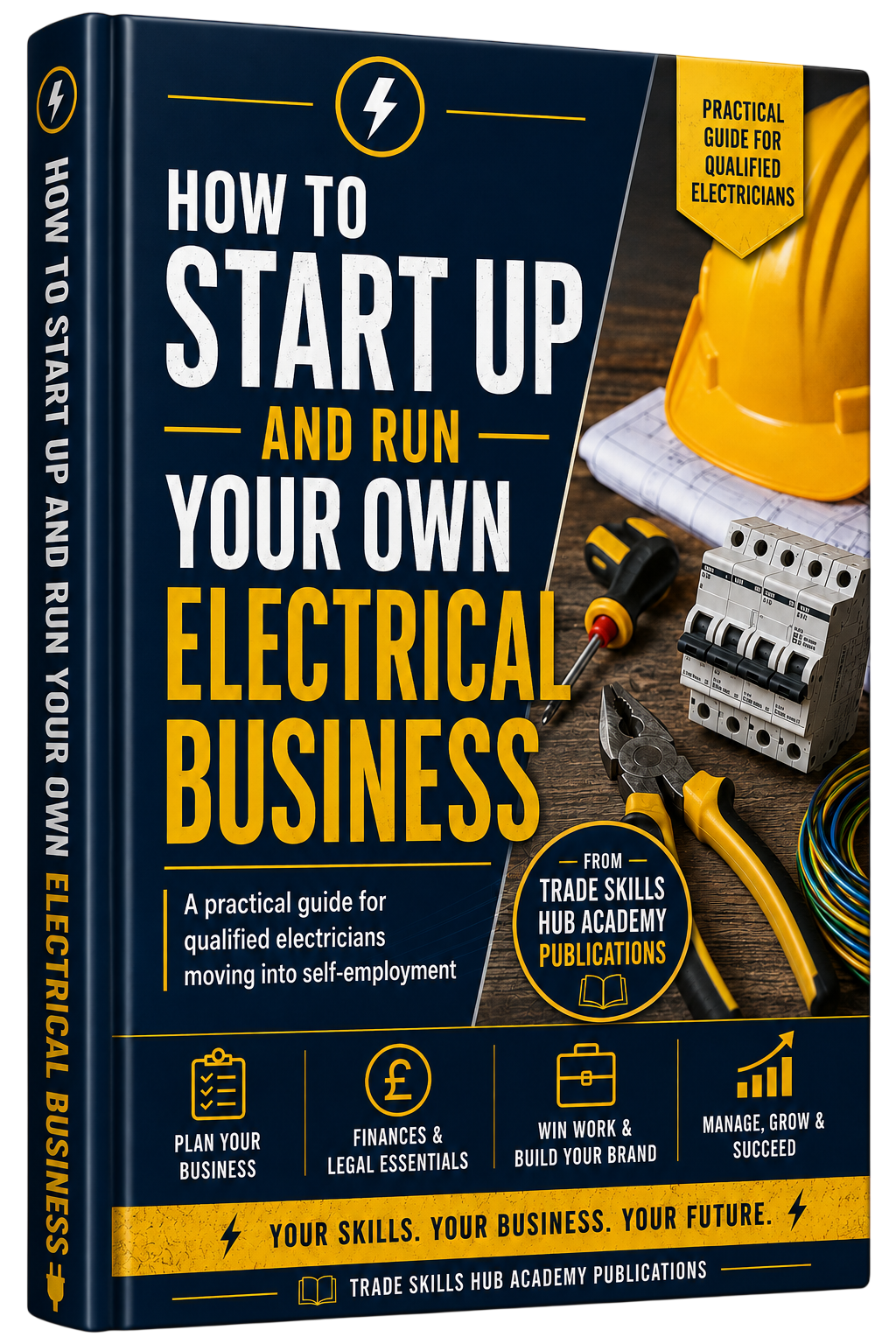
If you’d like a complete, step-by-step guide to becoming self-employed, How to Start Up and Run Your Own Electrical Business takes you through every stage of building an electrical business—from deciding whether self-employment is right for you to pricing work, finding customers, managing cash flow and growing a successful company. It is written specifically for qualified electricians moving into self-employment. You’ll find it alongside our other trade titles in the full range of trade business start-up guides.