
BLOG
How to Start an Oven Cleaning Business:
A Complete Guide for 2026
Introduction
Ask a room full of people to name the household chore they put off the longest and the oven wins almost every time. It is awkward, messy, time-consuming, and a Sunday afternoon spent with a supermarket spray rarely produces a result anyone is proud of.
That everyday reluctance is the foundation of an entire trade. And it is why a well-run oven cleaning business can build a loyal customer base faster than almost any other domestic service.
If you have been searching for how to start an oven cleaning business, this guide walks through what the trade actually involves, what it costs to get going, and what separates the operators who last from the ones who quit inside a year.
Why oven cleaning is one of the most accessible trades to start
Compared with most trades, the barriers here are low:
- The equipment fits in a modest van. No workshop, no yard, no heavy plant.
- Training takes days, not years. There is no apprenticeship and no mandatory qualification.
- Demand is everywhere. Every town, every type of household, every income bracket.
- You can start part-time. Plenty of operators build the round alongside existing work before going full-time.
Customers do not pay for oven cleaning because they are incapable. They pay for three reasons: time, because a proper deep clean of a neglected double oven can swallow most of a day; results, because domestic products used cold cannot match what a professional achieves with a heated dip tank and a properly stripped-down appliance; and unpleasantness, because many have tried it once and vowed never again.
When a service saves people time, delivers a result they cannot achieve themselves, and removes a job they hate, you have the ingredients of a durable business.
What the work really involves
Before you spend a penny, be honest about the day-to-day. Oven cleaning is physical. You will kneel, lift, carry, and work with your head and arms inside appliances. You will handle caustic chemicals that demand respect and proper protective equipment. You will work in other people’s kitchens, which means care, cleanliness and communication matter as much as technical skill.
It also means you need reasonable fitness, a tolerant back, and the temperament to stay pleasant when a customer’s oven turns out to be twice the job you quoted for.
Oven cleaning business startup costs and equipment
You are realistically looking at a van (or a suitable estate car to begin with), a heated dip tank, cleaning solutions, hand tools, protective equipment, floor and worktop protection, and basic branding. Add insurance, registration and a small marketing budget.
Rather than quote figures that date badly, the sensible approach is to price your own list from current suppliers before you commit. What matters is the principle: this is one of the cheapest trades to enter properly, but “properly” is the operative word. Cutting corners on protective equipment or on the dip tank is how people end up with damaged appliances, angry customers and no insurance cover.
Franchise or independent: which route suits you?
This is the first big fork in the road, and it deserves more thought than most people give it.
A franchise offers a recognised name, a proven system, supplied equipment and, usually, some marketing support. You pay for it — upfront, and often as an ongoing percentage — and you accept the operating restrictions that come with it.
Going independent means keeping every pound you earn and running the business your way, but you build the brand, the systems and the customer base from nothing.
Neither route is automatically right. The honest comparison depends on how much capital you have, how confident you are at marketing, and how much you value autonomy over structure.
Legal, insurance and safety groundwork
Before your first paid job you need to have covered:
- Business structure and registration — sole trader or limited company, and registering with HMRC.
- Insurance — public liability at a minimum, plus cover for treatment risk, tools and the van.
- COSHH and chemical safety — caustic products require proper storage, handling, protective equipment and safety data sheets.
- Waste disposal — spent solutions and residues cannot simply go down the drain.
Regulations and thresholds change, so always confirm the current position with GOV.UK or a qualified professional before acting.
Pricing your oven cleaning services
Pricing is where new operators most often go wrong, usually by undercutting the established local firms to win work. It is a trap: cheap prices attract price-shoppers, and price-shoppers do not become repeat customers.
Price on the realistic time a job takes, the wear on your equipment, your travel, and the margin you need to still be running in five years. Build a clear structure — single oven, double oven, range, hob, extractor, microwave — so quoting over the phone is quick and consistent.
Marketing an oven cleaning business locally
This trade is unusually well suited to local marketing because the results photograph so well.
- Google Business Profile and reviews. For a local service business, this is the single highest-return marketing asset you have. Get it complete, get it verified, and ask every satisfied customer for a review.
- Before-and-after photos. Carbon-black to showroom-bright is a transformation most customers genuinely did not believe was possible. Photograph every job.
- A simple, fast local website. It does not need to be elaborate. It needs to load quickly, state your service area, and make booking easy.
- Social media. Local Facebook groups and community pages convert extremely well for domestic services.
- Leaflets and partnerships. Estate agents, letting agents, end-of-tenancy cleaners and holiday-let owners all have repeat oven cleaning needs.
- Repeat business. Most households want an annual or six-monthly clean. A well-kept customer list is worth more than any advertising campaign.
Growing beyond one van
Once the round is full, the choices are to raise prices, tighten routes and scheduling, or take on a second operator and a second van. Each route changes the business. Growth for its own sake is not always the right answer, and plenty of successful oven cleaners deliberately stay solo and simply get better paid.
Staying well in the long haul
Oven cleaning is seasonal — Christmas and end-of-tenancy periods spike, quieter months follow. It is also physically demanding and, for most operators, solitary. Protecting your body, managing the peaks and lulls, and staying motivated when you are working alone are what separate a business that lasts a decade from one that burns out in eighteen months.
Get the complete guide
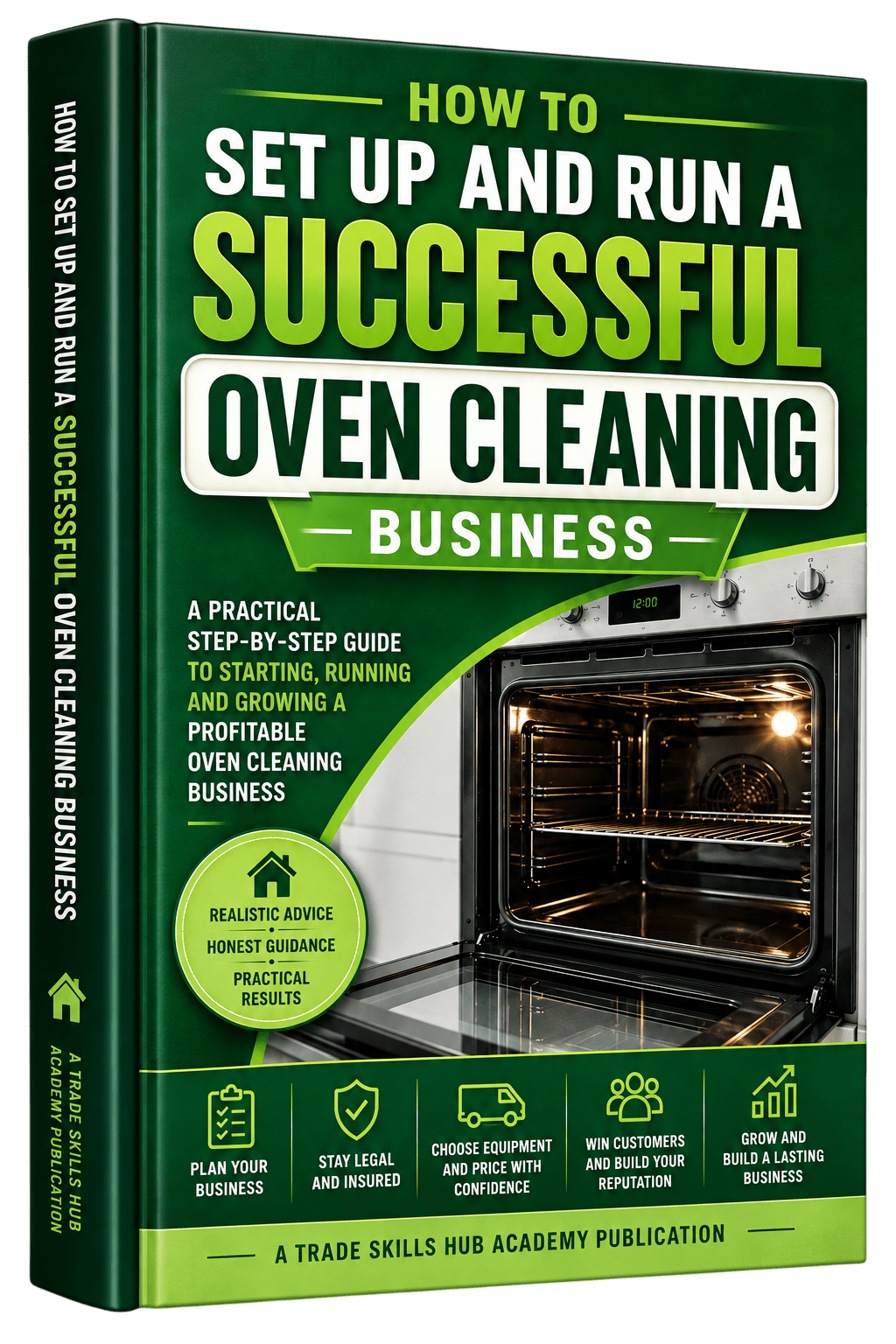
How to Set Up and Run a Successful Oven Cleaning Business covers all of the above in full — 26 chapters, from deciding whether the trade suits you, through registration, insurance, chemicals, equipment and pricing, to marketing, the job itself step by step, difficult customers, bookkeeping, scheduling, growth and long-term wellbeing.
It also includes four practical appendices: a startup checklist, a job-day kit checklist, a pre-clean condition and customer record sheet, and a directory of useful organisations and further reading.
Written in plain English for the complete newcomer, with no jargon and no get-rich-quick promises — just what the work actually involves, what it actually costs, and what it actually takes to build a business doing it.
Part of the Trade Skills Hub Academy series of practical guides for tradespeople.