
BLOG
How to Run a Profitable Trade Business
A Practical Guide for Tradespeople
Introduction
Being good at your trade is only half the battle when you become self-employed.
You might be an excellent electrician, plumber, builder, painter and decorator, carpenter, handyman or other skilled tradesperson, but running a successful trade business requires a completely different set of skills.
You need to know how much your business really costs to run, how much you should charge, how to prepare quotations, how to manage customers, how to control cash flow and, eventually, whether you should employ someone or grow the business.
This is something that is often overlooked when people move from employment into self-employment. You may have spent years developing your technical skills, but nobody necessarily taught you how to calculate a profitable charge-out rate, price materials, manage cash flow or market a business.
That can lead to a frustrating situation: the diary is full, the van is busy and customers are paying — but there isn’t as much money left at the end of the year as there should be.
The good news is that running a profitable trade business doesn’t have to be complicated.
It starts with understanding the numbers.
Being busy doesn't necessarily mean being profitable
One of the biggest mistakes a self-employed tradesperson can make is assuming that being busy means the business is successful. Imagine that you have work booked for the next three months. You are working long hours and sending invoices every week. From the outside, it looks like you’ve built a successful business. But how much are you actually earning?
Turnover isn't profit.
Your business has to pay for fuel, insurance, tools, materials, vehicle costs, accountancy, software, advertising and many other expenses before you can calculate what you’ve really earned.
There is another problem.
Some of your working time isn’t directly chargeable.
You might spend an hour travelling to a quotation, another hour preparing the quotation, time ordering materials, answering customer messages and dealing with paperwork.
None of those activities necessarily appears as a chargeable hour on a customer’s invoice.
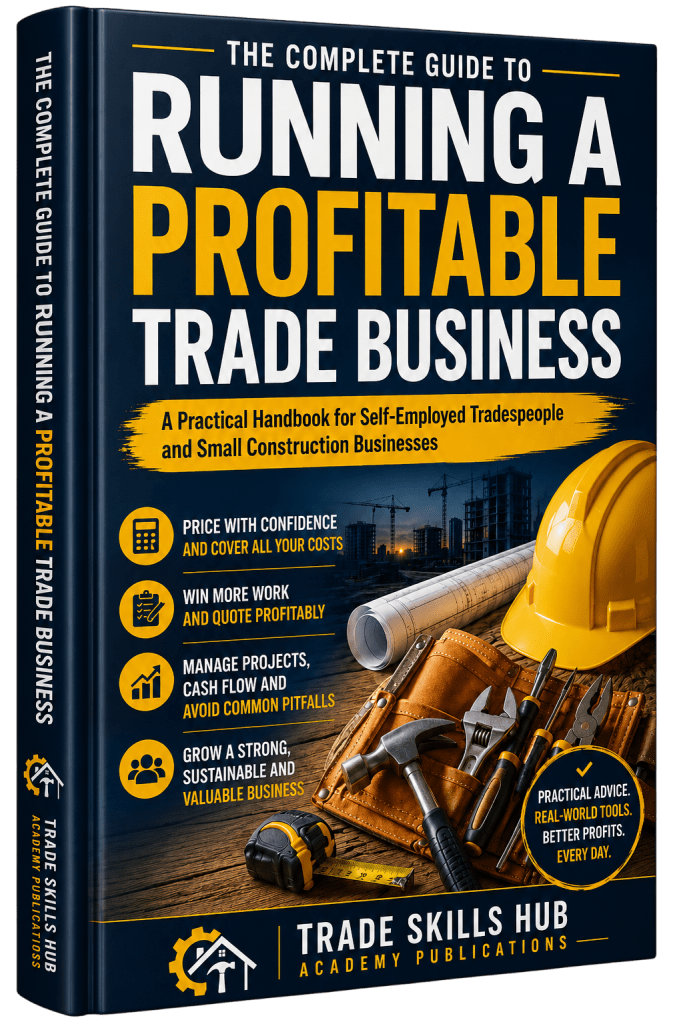
The Complete Guide to Running a Profitable Trade Business therefore makes a distinction between simply being busy and actually running a profitable business. Every decision — from calculating your charge-out rate to chasing an overdue invoice — can affect profitability.
If you’re considering becoming self-employed, the Trade Business Start-Up Guides from Trade Skills Hub Academy provide practical guidance covering business planning, pricing, marketing, finance, customer service, systems and business growth.
Understand what your trade business really costs
Before deciding what to charge customers, you need to know what your business costs. Some costs are obvious:
- Van payments
- Fuel
- Insurance
- Tools
- Materials
- Mobile phone
- Accountancy
- Advertising
- Software
But there are less obvious costs too.
Your business still has expenses when you’re not working on a customer’s property.
Think about holidays, sickness, training, quoting, travelling, administration and time spent chasing invoices.
These activities are part of running the business, even though you can’t necessarily put them on an invoice.
If you ignore them when calculating your prices, you may unknowingly be subsidising your customers with your own time.
The handbook recommends calculating your costs over a complete trading year rather than simply trying to estimate what you spend during an average month. This provides a much more realistic picture of what the business needs to generate.
This is one of the foundations of profitable pricing.
Calculate your real charge-out rate
One of the most important figures in any trade business is your charge-out rate.
Unfortunately, many tradespeople arrive at their hourly or daily rate by looking at what other local tradespeople charge.
That’s understandable, but it isn’t necessarily a sound business calculation.
Your overheads might be completely different from those of another tradesperson. You might have a newer van, higher insurance costs, different tools, different working patterns or different income requirements.
A proper charge-out rate should therefore be calculated rather than guessed.
The handbook explains that a calculated rate starts with your real overhead, vehicle and labour costs and your genuinely chargeable hours, with a deliberate profit margin added.
This is particularly important because you cannot realistically bill every hour you spend working.
If you have a 40-hour working week, perhaps only 30 hours are genuinely chargeable. The remaining time might be spent travelling, preparing quotations, ordering materials, carrying out administration or dealing with customers.
Your charge-out rate therefore needs to recover your costs across the hours you can actually invoice — not the hours you theoretically have available.
A useful tool for calculating your pricing
The Trade Profit App has been developed specifically around this problem. It includes calculations for overheads, vehicle costs, labour rates, material mark-ups, job profitability, forecasts and actual hourly earnings.
The aim is to move away from asking, “What do other tradespeople charge?” and towards asking, “What does my business need to charge to be profitable?”
Don't give away your profit on materials
Materials can represent a substantial proportion of the value of a trade job.
Yet some tradespeople simply add up their supplier invoices and charge the customer exactly what they paid.
That means the business earns nothing from supplying the materials.
But supplying materials isn’t completely free.
You have to find the right products, compare prices, place orders, arrange collection or delivery, check deliveries and deal with incorrect or damaged items. You may also have to finance those purchases until the customer pays.
The handbook therefore discusses applying a material mark-up rather than simply passing materials through at cost. It gives 15–30% as a general starting reference, while recognising that the appropriate level depends on the trade, material and circumstances.
The important lesson isn’t that every tradesperson should use exactly the same percentage.
It’s that material pricing should be deliberate and consistent.
The Trade Profit App also includes material mark-up calculations alongside its other pricing and profitability tools. (Trade Skills Hub Academy)
Prepare professional quotations
Once you’ve calculated your labour and materials, you need to turn those figures into a quotation.
A professional quotation should make it clear to the customer what they’re paying for.
Depending on the type of work, it may need to explain:
- The work included
- Materials included
- Labour
- What isn’t included
- Timescale
- Payment terms
- Important assumptions
- How additional work will be dealt with
This can prevent misunderstandings later.
A quotation isn’t just a document telling someone what a job will cost.
It is also an opportunity to demonstrate that you are organised and professional.
The Trade Business Start-Up Guides include pricing and quoting as one of their core subjects, alongside business planning, finance, marketing, customer service and business growth.
Learn to manage variations
Even a carefully priced job can change once work begins.
The customer may decide they want additional work.
You may discover something that couldn’t reasonably have been identified before the job started.
Another part of the project may need changing.
These changes are commonly referred to as variations.
The danger is agreeing to additional work without agreeing the price.
“While you’re here, could you just…”
Those words have probably cost many tradespeople money over the years!
If additional work isn’t recorded and priced properly, you can end up spending several hours on extra work without receiving the profit you expected.
Good variation management protects both the customer and the tradesperson.
Plan the job before you start
Winning a profitable job is only half the battle.
You then have to deliver it profitably.
Poor planning can quickly destroy a margin.
Materials aren’t available.
The customer hasn’t cleared the work area.
Another trade hasn’t completed their part of the job.
You discover an access problem.
A delivery is delayed.
Every unnecessary hour spent dealing with these problems reduces your profit.
The handbook recommends breaking work into stages and identifying materials, dependencies, access issues and potential delays before starting.
A few minutes of planning before starting can save hours later.
This becomes even more important as your business grows and you have several jobs or employees to coordinate.
Manage your cash flow
Profit and cash aren’t the same thing.
You could have completed £20,000 of work and invoiced your customers, but if £15,000 hasn’t yet been paid, you don’t have £20,000 available to spend.
Meanwhile, your suppliers still want paying.
So do your insurance company, finance company and HMRC.
This is why cash-flow management is essential.
You need to know:
- How much money is coming in?
- When is it coming in?
- How much money is going out?
- When does it need to be paid?
Good accounting and record keeping make this much easier.
The Trade Business Start-Up Guides specifically cover finance and cash flow, recognising that financial management is one of the key areas where new business owners need practical support.
The trade business app is also designed to help tradespeople understand operating costs, job profitability and business forecasts.
Don't automatically take on employees
When your diary becomes full, you may start thinking about employing someone.
It can be an excellent way to grow a business.
But it shouldn’t be an automatic decision.
You need to ask whether the additional work is likely to continue.
Can you keep the employee busy?
Can the business afford their complete employment cost?
Are your pricing and administration systems ready?
The handbook explains that employing someone changes the financial structure of the business and means pricing needs to be reviewed.
The alternatives may include an employee, apprentice or subcontractor, depending on the circumstances.
Growth should therefore be planned rather than simply being a reaction to having too much work.
Marketing: find more of the right customers
Once the foundations are in place, you need customers.
Marketing is an important part of running any modern trade business.
That can include:
- A professional website
- Search engine optimisation
- Google Business Profile
- Customer reviews
- TikTok
- YouTube
- Recommendations
- Repeat customers
- Local networking
- Partnerships and referrals
But remember the central lesson of this article.
More enquiries aren't automatically better.
If your prices are too low, excellent marketing can simply give you more unprofitable work.
Marketing works best when it sits on top of solid costing and pricing systems.
Trade Skills Hub Academy’s How to Market Your Trade Business is a two-volume marketing system specifically aimed at UK trade businesses. It covers websites, SEO, Google Business Profile, social media, reviews, paid advertising, networking, referrals, email marketing, AI and performance tracking.
That makes it a natural next step for a tradesperson who has established their pricing and now wants to build a reliable flow of enquiries.
Consider commercial work and tendering
Domestic work isn’t the only route to growth.
As your business develops, you may consider commercial contracts or tender opportunities.
Tendering, however, requires a different approach from simply responding to a homeowner asking for a price.
A tender is generally assessed against specific criteria. Your submission needs to answer the questions asked, provide evidence and meet the stated requirements.
The handbook stresses the importance of deciding whether an opportunity is suitable before committing significant time to it. It also highlights the dangers of pricing too low simply to win a contract.
The Winning More Work section of Trade Skills Hub Academy is designed to help tradespeople develop their approach to finding and winning additional work.
The key principle is the same as domestic work:
Winning the work is only worthwhile if you can deliver it profitably.
Use technology to save time
Technology can now take care of many repetitive tasks that once consumed evenings and weekends.
Accounting software can help with financial records.
Quoting software can produce professional quotations.
Scheduling software can help organise jobs.
CRM systems can keep customer information and previous jobs together.
Artificial intelligence can also help with everyday administration.
The handbook identifies several useful applications for AI, including drafting quotations, social media posts, website content, customer responses and job plans.
However, AI should be treated as an assistant rather than an authority.
It can produce convincing answers that are wrong, particularly when dealing with regulations, safety standards or technical information.
Anything important should therefore be checked against an appropriate authoritative source.
Build systems instead of relying on memory
As your business develops, you don’t want to reinvent the wheel every time you quote a job.
Templates, worksheets and checklists can make a huge difference.
You might have a standard:
- Quotation template
- Invoice template
- Job checklist
- Materials checklist
- Site-start checklist
- Job-completion checklist
- Vehicle checklist
- Customer information form
The handbook describes templates, worksheets and checklists as a practical toolkit that turns good business principles into repeatable everyday processes.
The important thing is actually to use them.
A checklist sitting in a folder doesn’t improve your business.
A checklist that you use every day might.
The ultimate aim: a trade business that pays you properly
Running a profitable trade business isn’t about finding one magic formula.
It is about getting lots of relatively simple things right.
You need to understand your costs.
You need to calculate your charge-out rate.
You need to price materials properly.
You need to prepare professional quotations.
You need to manage variations.
You need to plan jobs.
You need to control cash flow.
You need to market effectively.
And if you decide to grow, you need systems that allow the business to grow without your profits disappearing.
That is the philosophy behind the Complete Guide to Running a Profitable Trade Business.
The handbook follows a structured route from understanding costs and calculating a charge-out rate through estimating, materials, quotations, winning work, project management, cash flow, profit and loss, marketing, staff, technology and AI.
The important thing is that these areas are connected.
There is little point in having an excellent marketing campaign if you are underpricing every job.
There is little point in winning lots of work if poor planning causes you to lose your margin.
And there is little point in generating a healthy profit on paper if customers aren’t paying you on time.
A profitable trade business is built by getting all of these pieces working together.
Ready to take control of your trade business?
If you’re thinking about becoming self-employed, or you already run a trade business and want to improve the way you manage it, the Trade Business Guides provide practical guidance on starting, pricing, marketing, managing finances, winning repeat business and growing a sustainable business.
If pricing and profitability are your biggest concerns, take a look at the Trade Profit calculator, developed specifically to help tradespeople understand their costs, calculate charge-out rates and measure job profitability.
And if you need more customers, explore Trade Business Marketing Guide for a practical approach to websites, SEO, Google Business Profile, social media, reviews, referrals and other marketing channels.
Because ultimately, the aim isn’t simply to build a trade business that keeps you busy.
It’s to build one that pays you properly for your skill, your time and the risks you take — and remains profitable year after year.