BLOG
Free Toolbox Talk Generator for Tradespeople: Create Practical Safety Briefings in Minutes
This guide is written around the UK trade scenario, but the estimating principles apply in most English-speaking nations.
Introduction
A good toolbox talk takes ten minutes and can prevent a serious injury. A bad one takes ten minutes and changes nothing. The difference is usually preparation. When a supervisor reads a generic sheet that has nothing to do with the job in front of the team, people stop listening. When the talk is about the work they are doing today, on the site they are standing on, it sticks.
Our free Toolbox Talk AI Prompt Builder helps you prepare the kind of talk people actually listen to. You choose the topic and duration, describe your team and the site, and add any issue you want to emphasise. The tool builds a detailed prompt you can paste into ChatGPT, Gemini, Copilot or any other AI assistant to create a short, practical toolbox talk, complete with knowledge-check questions and an attendance sign-off sheet.
What Is a Toolbox Talk?
A toolbox talk is a short, informal safety briefing delivered to workers on site, usually before the start of a shift or a new stage of work. It focuses on one topic — such as ladders, dust, manual handling or electrical isolation — and reminds the team of the hazards and the safe way to work.
Toolbox talks are sometimes called safety talks, tailgate talks or site briefings. Whatever the name, the purpose is the same: to keep safety at the front of people’s minds and to deal with issues on the job as they arise.
Why Toolbox Talks Matter for Small Trade Businesses
Toolbox talks are not just for large construction firms. They are just as valuable for a small electrical, plumbing, roofing or decorating business with two or three operatives and an apprentice. In a small team, one accident can put the whole business out of action.
- They prevent accidents. Regular reminders about the hazards people face every day reduce the chance of shortcuts becoming habits.
- They deal with problems quickly. If you notice something unsafe on site, a toolbox talk the next morning addresses it while it is still fresh.
- They help new starters and apprentices. A short talk gives less experienced workers clear, practical rules to follow.
- They give you a record. A signed attendance sheet shows that you have given your team information and instruction on specific topics — which is part of your duty as an employer, and something clients and main contractors often ask to see.
- They show clients you take safety seriously. Many contractor approval schemes and tender questionnaires ask how you brief your workers.
A toolbox talk does not replace proper training, competence or supervision. It supports them.
How the Toolbox Talk AI Prompt Builder Works
The tool asks a few short questions and turns your answers into a detailed prompt with clear instructions for the AI. There are three steps:
- Complete the short form, choosing your topic and duration.
- Click “Create My AI Prompt” to generate your personalised prompt.
- Copy the prompt and paste it into your preferred AI assistant.
The AI then produces a toolbox talk written to be read aloud on site.
Choose from 20 common trade safety topics
The tool includes a ready-made list of topics that come up again and again in the trades: working at height, ladders and step ladders, manual handling, electrical safety, isolation and lock-off, slips, trips and falls, dust and respiratory hazards, PPE, portable power tools, hand tools, noise, vibration and HAVS, COSHH and hazardous substances, asbestos awareness, fire safety, hot work, lone working, housekeeping, vehicle and site traffic safety, and working around customers and the public. If your subject is not on the list, choose “Other” and describe it — for example, the safe use of mobile towers.
What else the tool asks you
- Your business name and trade or type of work
- How long the talk should last — 5, 10 or 15 minutes
- Who the talk is for — for example, two electricians and one apprentice working in occupied commercial premises
- The work or site context, such as refurbishment work in an occupied school
- Any particular issue you want emphasised
- Any recent incident, near miss or observation you want to refer to
- The tone — practical and straightforward, friendly but professional, or firm and safety-focused
- How many knowledge-check questions you want — 3, 5 or 7
The more specific you are about the team and the site, the more relevant the talk will be.
What Your Toolbox Talk Will Include
The prompt tells the AI to structure your talk in nine sections:
- Why this matters — a short explanation of why the topic is important to the people doing this work.
- Main hazards — the key hazards relevant to the topic and your site.
- Safe working rules — practical, concise rules to follow.
- Common mistakes to avoid — realistic unsafe shortcuts relevant to the topic.
- What you must do before starting — the checks that genuinely apply.
- What to do if something goes wrong — proportionate, practical actions.
- Key takeaways — three to five short points for the team to remember.
- Knowledge check — questions to ask the group, with the expected answer shown in brackets for the person delivering the talk.
- Attendance and sign-off — blank fields for site or project, date, who delivered the talk, attendee names, signatures, and comments or actions arising.
That gives you everything you need on a single document: the talk, a way to check people understood it, and a record that it took place.
Knowledge-Check Questions: Make Sure the Message Landed
Reading a talk aloud does not mean anyone took it in. The knowledge-check questions give the person delivering the talk a quick, practical way to test understanding before the team starts work. Because the expected answers are provided, a supervisor who is not a safety specialist can still run the check with confidence.
If someone cannot answer a question, that is useful information. It tells you where further explanation, training or supervision is needed — before it matters on site.
Using Near Misses and Incidents Without Blame
The most effective toolbox talks often start with something that has actually happened: a ladder used without being checked, an extension lead left across an access route, or a customer walking into a work area. Real examples make the risk obvious in a way that general advice never does.
The tool lets you describe a recent incident, near miss or observation, and the prompt tells the AI to refer to it generically and constructively, without blaming individuals. That matters. If people feel a toolbox talk is being used to single them out, they stop reporting near misses — and near misses are your best early warning of a serious accident.
Do not include personal or confidential details in the form. Describe what happened, not who did it.
Built-In Safeguards
This tool creates an AI prompt. The toolbox talk the AI produces is a draft. A toolbox talk is a short safety briefing, not a substitute for proper training, supervision, a suitable risk assessment, a method statement, manufacturer instructions or any legally required competence.
Before you deliver it, read it through and check it against the actual work, the site conditions, your current risk assessment and your procedures. Remove anything that does not apply, add anything that is missing, and confirm any point the AI has flagged for checking.
Important: A Readiness Score Is a Guide, Not a Guarantee
This tool creates an AI prompt. The review the AI produces is based entirely on the information you provide. It is not a guarantee of eligibility, approval or contract award.
A high readiness score does not mean you will pass a particular prequalification stage or win a contract, and a low score does not mean you should never bid. Always check the exact requirements of the tender, framework or approved-supplier questionnaire you are applying for. Where legal, tax or financial questions arise, take appropriate professional advice.
Tips for Delivering Toolbox Talks That Work
- Keep it short. Ten minutes of focused talk beats thirty minutes of reading a document aloud.
- Deliver it where the work happens. Standing next to the scaffold, the consumer unit or the skip makes the message real.
- Pick topics that match the work. Talk about ladders on the day the ladders come out, not in the middle of a week of ground-level work.
- Get the team talking. Ask what they have seen go wrong. Experienced operatives often make the point better than any written talk.
- Record every talk. Keep the signed sheets with your site records, and follow up any actions arising.
- Build a programme. Plan a topic each week so that the key hazards in your trade are covered regularly throughout the year.
How Toolbox Talks Fit with Your RAMS
Your risk assessment identifies the hazards and controls. Your method statement sets out the safe sequence of work. A toolbox talk is how you make sure the people doing the job understand both. Before a new job or a new stage of work starts, a short talk based on the key points of your RAMS is one of the best ways to brief the team. Our free Risk Assessment and Method Statement AI Prompt Builders work alongside this tool.
Frequently Asked Questions
Yes. The tool is completely free to use. You only need access to an AI assistant, and most have a free version.
Most toolbox talks last between five and fifteen minutes. The tool lets you choose 5, 10 or 15 minutes, and the prompt tells the AI to keep the talk to that length.
There is no fixed rule. Many businesses hold one a week, with extra talks before a new stage of work, when new hazards appear or after a near miss or incident.
Keeping a signed attendance record is good practice. It shows you have given your team information and instruction on specific topics, and clients and main contractors often ask to see it. Every talk produced with this tool includes a sign-off section.
Yes. Choose “Other” and describe the subject, and the AI will build the talk around it.
No. A toolbox talk is a short safety briefing. It supports training, competence and supervision but does not replace them.
Any trade or service business — electricians, plumbers, heating engineers, builders, roofers, decorators, landscapers, window cleaners, pressure washing and gutter cleaning businesses, and more.
Create Your Next Toolbox Talk Today
Short, relevant toolbox talks keep your team safe, help you deal with problems before they become accidents, and give you a clear record of the safety information you have provided. The Toolbox Talk AI Prompt Builder produces a practical talk, a knowledge check and a sign-off sheet in minutes — ready for you to check and deliver on site.
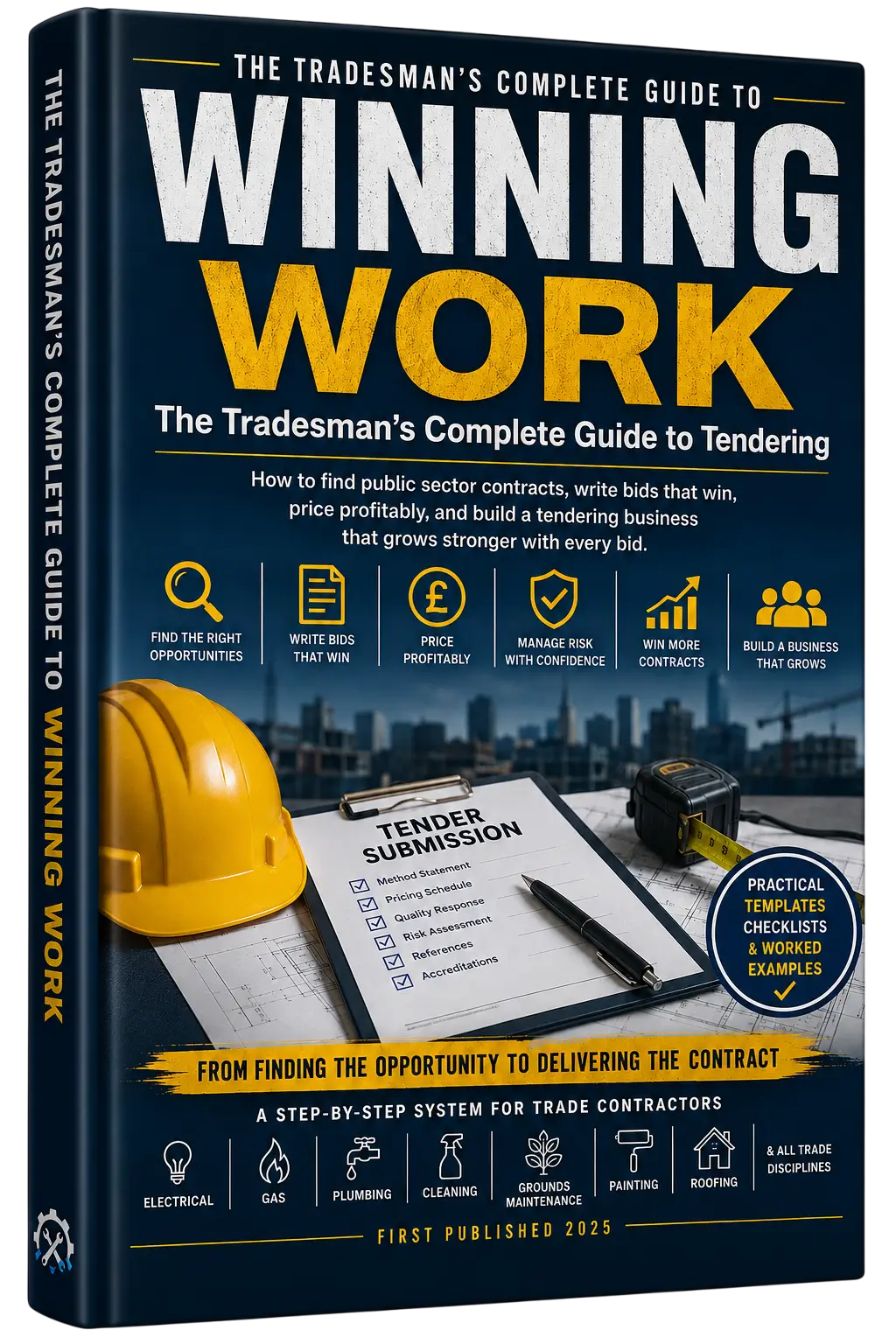
Need more RAMS and site-safety resources? Explore the Trade Skills Hub Academy guides, business resources and the Winning Work toolkit.