
BLOG
How to Build Your Own Estimating System (and Stop Guessing Labour Times)
This guide is written around the UK trade scenario, but the estimating principles apply in most English-speaking nations.
Introduction
Ask ten tradespeople how they price a job and most will describe the same thing: a figure that forms in their head, built from years of doing the work, nudged up or down depending on how the job feels on the day.
It works. Right up until it doesn’t. A job runs three days long. A margin comes in thinner than expected. A competitor quotes a number that makes no sense against the same scope of work, and you have no way of telling whether they are wrong or you are.
The problem is not a lack of experience. Experience is what makes a good estimator. The problem is that experience kept entirely in one person’s head cannot be checked, cannot be handed to anyone else, and cannot be improved on deliberately. A gut-feel price cannot be interrogated. A task-by-task, cost-built price can.
This post explains the alternative: building your own estimating database from your own completed jobs, so your prices come from evidence instead of instinct.
Why Published Rate Books Don't Solve the Problem
The usual answer to “I don’t know how long this takes” is to buy a rate book or a pricing guide. There are two problems with that.
The first is that published figures go stale the moment they are printed. Rates move, methods change, and the book on your shelf is a snapshot of the year it was written.
The second is bigger. A published figure is an average of other people’s businesses. It does not know that your team chases skirting faster than most. It does not know that your usual merchant’s pack sizes always leave you rounding up. It does not know your access, your patch, your crew, or your standard of finish.
A figure drawn from ten of your own completed jobs beats an industry average every time, because it is not an average at all. It is your own reality.
What an Estimating Database Actually Is
It is simpler than the word “database” suggests. It is a growing record of what you estimated against what the job actually took, one row per task, with a note explaining any difference.
At minimum, every entry records:
- The trade and the specific task — “skim wet walls,” not “plastering”
- Difficulty — easy, average or difficult conditions
- Quantity — square metres, linear metres, or number of items, where the task is priced by unit
- Estimated hours — what you allowed for when you quoted
- Actual hours — what it genuinely took, recorded honestly
- Number of operatives — so a one-person figure never gets confused with a two-person one
- Notes — the reason behind any difference: “wall out of true,” “old adhesive, harder to strip,” “floor square, no extra cutting”
After ten jobs, that record is mildly interesting. After a hundred, it is the most valuable pricing asset your business owns, and no competitor has a copy of it.
Labour Hours Versus Elapsed Job Time
Before you log a single figure, get this distinction straight, because confusing the two causes real pricing errors.
Labour hours are the actual working hours a task takes — the time a competent tradesperson spends physically carrying it out.
Elapsed job time is how long the job takes on the calendar, including drying times, curing times, waiting for deliveries, waiting for other trades, or the customer being unavailable for two days in the middle.
A plastering job might involve two hours of skimming labour and a forty-eight hour elapsed time before the next coat can go on.
Labour hours are what you price. Elapsed time is what you tell the customer to expect. Price elapsed time as if it were labour time and your quote will look absurd. Quote labour time but promise an elapsed schedule to match, and you will run late on every job with a drying or waiting element in it.
Where Your First Figure Comes From: The AI Cross-Check Method
There is an obvious problem with building a database from your own jobs. On day one, you have no data. You still have to quote something.
This is where AI earns its place in estimating, and it is easy to get the role backwards. AI does not price the job. It gives you a defensible starting figure that your own experience then tests.
It works in five steps.
State the exact scope, what is included and what is explicitly excluded. Keep fault-finding and remedial work separate from a base installation figure, so the number you get back answers the question you actually asked.
Not a bare number. A figure with no visible reasoning cannot be checked, and a figure that cannot be checked should not be trusted.
Is the figure based on genuine industry guidance, or on something thinner dressed up to look authoritative? This step catches more errors than any other.
This is the step no AI can do for you, and it is the step that turns a generic draft into a figure you can stand behind. For trades outside your own hands-on background, buy a short sense-check from someone who does practise that trade. A starting figure checked by nobody is not a starting figure. It is a guess with a source attached.
Log the estimate against the actual outcome. From then on, your own data starts replacing the draft.
A Worked Example: Replacing a Consumer Unit
Task defined: install a 12-way split-phase metal consumer unit with surge protection device, including meter tails, main earthing conductor, main earthing terminal, main protective bonding to gas and water services, and connection of existing final circuits. Fault-finding and remedial work explicitly excluded.
The AI-drafted range came back as roughly 6 to 7 hours for easy conditions, 8 to 10 for average, and 12 to 16 for difficult.
The source check is where it got interesting. The safety and scope guidance the AI cited was genuine and held up under scrutiny. The hours figures themselves traced back to a consumer-facing cost-comparison website, not a proper estimating data source. A citation can be real and still be poor evidence for the number attached to it.
The real recorded time for that exact job, same scope, same exclusions, was 8 hours. That lands squarely inside the average band, which validates the method. But it is the recorded 8 hours that goes into the database, not the AI’s draft.
That is the whole point. The draft gets you to a defensible starting point quickly. Your own recorded result is what goes on record.
The Three-Band System: Why One Number Is Never Enough
Publishing a single “typical” figure for a task pretends that one number can honestly represent every tradesperson, every property and every job. It cannot.
Work instead in three bands:
| Band | What it represents |
| Standard time | Reasonable working conditions — the baseline most jobs should be estimated from |
| Low range | Straightforward, repetitive work, favourable conditions, good access |
| High range | Difficult existing-property conditions, poor access, occupied property, older buildings |
The formula underneath is simple: base labour time × difficulty factor = estimated labour time. A task that takes four hours in an empty, easily accessible new-build might take five in an occupied, restricted-access existing property, with nothing about the task itself having changed.
The Task Library: 467 Tasks Across 15 Trades
Breaking a job into tasks by hand is the skill. Having a ready-made list to break it against saves hours.
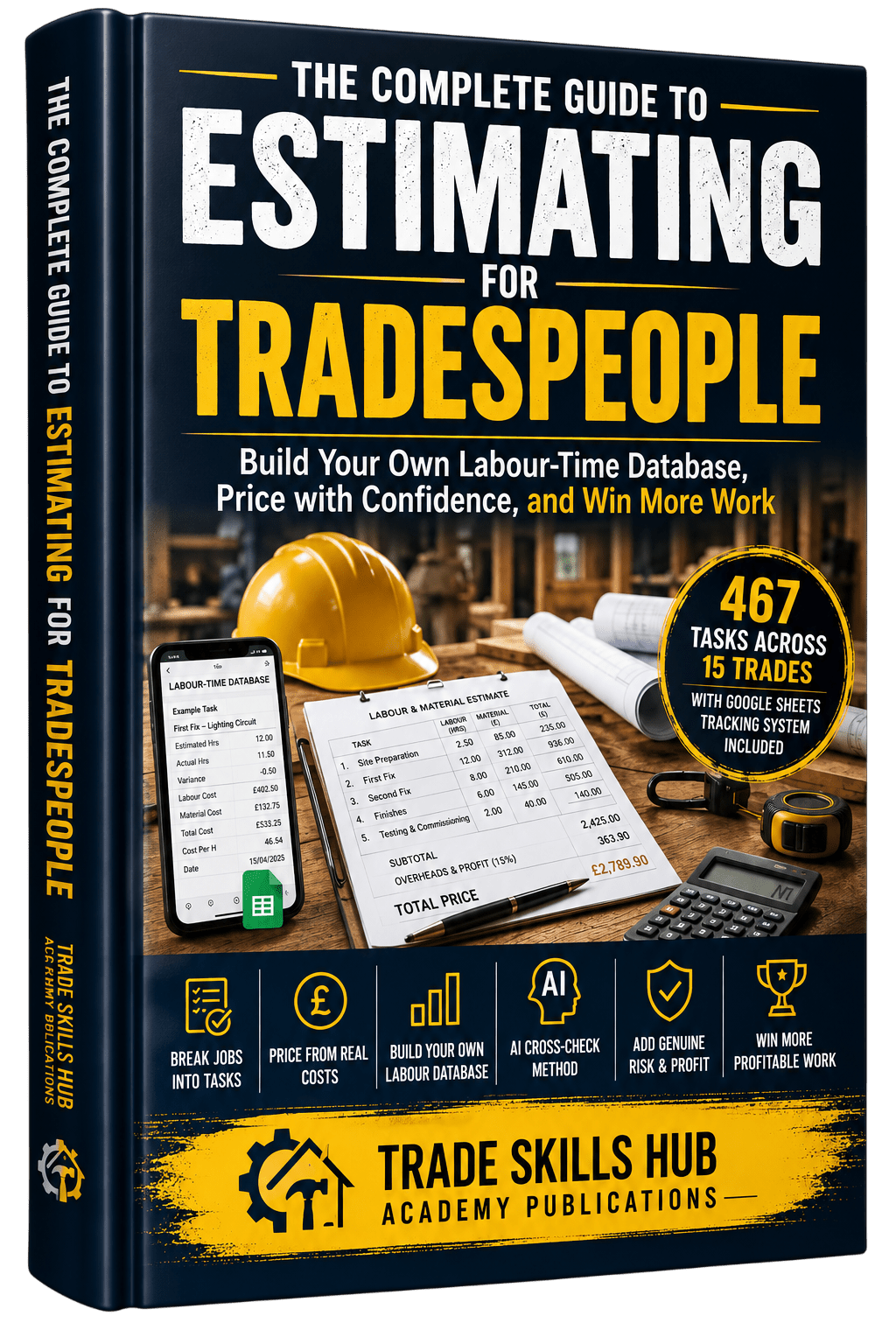
The task library behind The Complete Guide to Estimating for Tradespeople covers 467 individually scoped tasks across fifteen trades, from a single socket outlet to a full property rewire. Each trade has its own task categories, scoped to avoid overlapping with neighbouring trades:
| Trade | Task categories |
| Electrical | 12 |
| Plumbing & Heating | 15 |
| Carpentry & Joinery | 12 |
| Painting & Decorating | 8 |
| Plastering & Drylining | 7 |
| Brickwork & Masonry | 8 |
| Roofing | 10 |
| Tiling | 9 |
| Flooring | 7 |
| Groundworks & Landscaping | 11 |
| Kitchen Fitting | 10 |
| Bathroom Fitting | 9 |
| General Building / Handyman | 7 |
| Window & Door Installation | 6 |
| Insulation | 9 |
Units vary sensibly by trade: square metres for plastering and flooring, linear metres for fencing and skirting, per-item for doors and radiators, cubic metres for groundworks.
How to Set Up Your Own Database in Five Minutes
You do not need estimating software, a subscription, or a licence. The system is built in a free form-and-spreadsheet setup, and it belongs entirely to you.
- Open the template link and make your own copy. This is the step that matters for privacy. It creates a brand new form and a brand new linked spreadsheet, both inside your own account. Nobody else can see it.
- Rename it to whatever you will recognise in your own drive.
- Add it to your phone’s home screen. One tap between jobs, no URL to type, no bookmark to lose.
- Fill it in once per task, as soon as possible after finishing. The details are freshest right then, and a habit done immediately survives far longer than one left for later.
- Read your own data. Every submission lands in the linked sheet as a new row. Sort by task name and eyeball the estimated against actual columns. That alone starts showing patterns. As the log grows, a simple average-by-task formula turns dozens of entries into one genuinely evidence-based figure.
Logging takes under a minute per task. A full bathroom refurbishment broken into forty-three tasks means forty-three submissions, which sounds tedious written down and takes about half an hour in practice, spread across the job.
What Changes When You Price From Real Data
Three things, and they compound.
Your quotes become defensible. When a customer questions a price, you are explaining a build-up of tasks, hours and costs rather than defending a number you cannot account for.
Your losses become useful. A quote that loses against a competitor tells you something specific when your own costing is transparent. When it isn’t, all you learn is that you were more expensive.
Your margin stops being a surprise. Checking gross profit against true labour cost before the quote leaves your hands means you know what a job is worth to you before you commit to it, not after you invoice it.
Frequently Asked Questions
You get value from the first few entries, because the notes column tells you why things ran over. Around ten logged entries for the same task is where your own average starts beating a published figure.
No. A free form linked to a spreadsheet does everything described here. Dedicated software becomes worth considering later, once logging is already a habit.
Every task, if you can. The repetitive small tasks are where the money quietly leaks, and they are the ones where a reliable average is easiest to build.
Not on its own. Use it to draft a starting range with visible reasoning and sources, then check the sources and test the range against your own experience. Treat the output as a first draft to be challenged, never a finished price.
Buy a short sense-check from someone who does practise that trade before you rely on the figure. It costs far less than a job that runs two days over.