
BLOG
Free Tender Readiness Checker for Tradespeople: Find Out If Your Business Is Ready to Bid
This guide is written around the UK trade scenario, but the estimating principles apply in most English-speaking nations.
Introduction
Many trade businesses reach a point where domestic work is no longer enough. They want steadier, larger contracts — housing associations, schools, local authorities, facilities management companies and main contractors. Getting that work almost always means filling in a prequalification questionnaire, applying to an approved-contractor list or submitting a tender.
That is where many good tradespeople fall down. Not because they cannot do the work, but because they cannot prove it on paper. The buyer asks for an insurance schedule, a health and safety policy, sample RAMS, three references and two case studies, and the business has none of them ready. The deadline passes, or the submission scores badly, and the opportunity goes to a competitor who was better prepared.
Our free Tender Readiness Checker shows you where you stand before that happens. You tell it about your business and tick the documents and systems you already have. The how to tender for contracts tool builds a detailed prompt you can paste into ChatGPT, Gemini, Copilot or any other AI assistant to get a tender readiness score out of 100, a list of your gaps and a practical 30-day action plan.
Why Tender Readiness Matters
Tendering rewards preparation. Buyers usually set tight deadlines and expect evidence, not promises. If you start gathering documents when the tender arrives, you will be rushing to write policies, chase references and dig out certificates at the same time as pricing the work. The quality of your submission suffers, and small mistakes can rule you out altogether.
A business that is tender-ready has its core documents, policies and evidence prepared in advance. When an opportunity appears, it can concentrate on answering the buyer’s questions well rather than scrambling to prove it exists. That is the difference between tendering occasionally and winning regularly.
How the Tender Readiness Checker Works
The tool works like a structured self-assessment. There are three steps:
- Tell the tool about your business and the work you want to win.
- Tick the documents and systems you already have from the checklist.
- Click “Create My AI Prompt”, copy the prompt and paste it into your preferred AI assistant.
The AI then produces a structured readiness review based on what you have told it.
About your business
The first part of the form asks for your business name, trade or service, business type (sole trader, limited company or partnership), business size, years trading, tendering experience, the type of work or contracts you want to win and the typical contract value you are targeting. Your tendering experience ranges from none at all to having won tendered contracts before, so the review is pitched at the right level for you.
The 30-point readiness checklist
The heart of the tool is a checklist of 30 documents and systems that commonly come up in prequalification and tender exercises. You tick the ones you already have. They cover:
- Insurance — public liability, employers’ liability and professional indemnity
- Policies — health and safety, environmental, equality and diversity, quality, data protection, anti-bribery and modern slavery
- Health and safety systems — risk assessments, method statements and RAMS, COSHH arrangements, training and competency records, accident and incident records, equipment inspection records and health and safety performance information
- Operational controls — subcontractor management, business continuity, waste and environmental controls, complaints procedure, contract-management arrangements, and cyber and information security
- Evidence of capability — trade accreditations and registrations, a company profile or capability statement, case studies, customer references and quotation or tender templates
- Financial and administrative information — accounts and financial information, and tax and company registration details
You can also list your accreditations, registrations and memberships — for example NICEIC, NAPIT, Gas Safe, CHAS, Constructionline or SafeContractor — and note anything you already know you are missing or struggling with.
Your Tender Readiness Score
The AI gives your business an overall score out of 100, based on seven areas:
- Business credibility and experience — 15 points
- Insurance, registrations and accreditations — 15 points
- Health, safety and operational controls — 20 points
- Policies, governance and compliance documentation — 15 points
- Evidence of capability, references and case studies — 15 points
- Financial and administrative readiness — 10 points
- Tendering systems and contract-management readiness — 10 points
Your score then falls into one of four ratings: Not Ready (0–39), Developing (40–59), Nearly Ready (60–79) or Strong Tender Readiness (80–100).
The prompt tells the AI to score cautiously where there is not enough evidence, rather than assuming you have something you have not mentioned. That keeps the score honest. A flattering score that does not reflect reality is no use to you when a real buyer starts asking for evidence.
What Your Readiness Review Will Include
Alongside the score, the review gives you a complete picture of where you stand and what to do next:
- Score breakdown — your score in each of the seven areas, so you can see exactly where you are strong and where you are weak.
- What you are doing well — the strongest parts of your current position.
- Important gaps — missing or weak documents, systems and evidence that could weaken a submission.
- Top five priority actions — ranked from highest to lowest priority, each with what to do, why it matters, and whether it is a quick fix, a medium task or a larger project.
- Documents you may commonly be asked for — a checklist grouped into eight categories, with each item marked ALREADY HELD, CHECK / UPDATE or POTENTIAL GAP.
- Tender evidence check — the evidence you should prepare to back up your claims, such as certificates, insurance schedules, training records, case studies, project photographs, references, CVs and sample RAMS.
- Buyer-specific checks — the questions to ask when a specific tender arrives.
- A 30-day tender-readiness action plan — a simple week-by-week plan to improve your readiness quickly.
- Final verdict — whether you appear ready to join supplier lists, complete prequalification questionnaires, submit smaller tenders or pursue larger and higher-risk contracts.
Claims Need Evidence
One of the most common mistakes in tender submissions is making claims without backing them up. Saying “we have an excellent safety record” scores poorly. Providing your accident records, training matrix and a sample risk assessment scores well.
That is why the review includes a dedicated tender evidence check. For each claim you are likely to make, it identifies the evidence a buyer may expect to see. Building that evidence library before you need it is one of the most valuable things a small business can do to improve its tender results.
Case studies and references deserve special attention. Many trade businesses have done excellent work for years but have never written it up. Start now: take photographs of good jobs, note the scope and value, and ask satisfied commercial customers whether they would act as a reference.
Built-In Safeguards: No False Promises
Tender requirements vary enormously between buyers, sectors and individual procurement exercises. A general AI assistant can easily give the impression that every buyer wants the same thing, or that holding a particular accreditation guarantees success. The prompt this tool creates tells the AI directly not to do that. It instructs the AI to:
- Never assume every buyer asks for the same documents.
- Never state that any item is mandatory or universally compulsory unless that requirement has been specifically provided.
- Never assume a named accreditation or policy guarantees tender success.
- Never invent qualifications, insurance limits, turnover, references, accounts, experience or compliance information.
- Never invent statutory requirements.
- Say so where something depends on contract size, sector, buyer or location.
- Flag buyer-specific requirements for public-sector or regulated-sector work, such as procurement rules, exclusion grounds, social value, data protection, safeguarding and cyber security.
- Never guarantee that the business will pass any prequalification stage or win work.
Public-Sector Tenders: Check the Rules for Each Opportunity
Public-sector work often comes with extra requirements. Depending on the contract, buyers may ask about social value, safeguarding, data protection, cyber security, modern slavery or specific financial thresholds. Public procurement rules have also changed in recent years, with new legislation governing how most public bodies in England, Wales and Northern Ireland buy goods, works and services, and Scotland operating its own rules. (This is correct at the time of writing; check the current guidance on GOV.UK and the buyer’s tender documents before bidding.)
The practical lesson is simple: a readiness review tells you how prepared you are in general. It does not replace reading the specific tender documents carefully. When an opportunity arrives, check exactly what that buyer is asking for, and answer every question it asks.
Important: A Readiness Score Is a Guide, Not a Guarantee
This tool creates an AI prompt. The review the AI produces is based entirely on the information you provide. It is not a guarantee of eligibility, approval or contract award.
A high readiness score does not mean you will pass a particular prequalification stage or win a contract, and a low score does not mean you should never bid. Always check the exact requirements of the tender, framework or approved-supplier questionnaire you are applying for. Where legal, tax or financial questions arise, take appropriate professional advice.
Tips for Becoming Tender-Ready
- Start with the basics. Insurance, a health and safety policy, and risk assessments and method statements are among the most frequently requested items.
- Build an evidence library. Keep certificates, insurance schedules, training records, photographs, case studies and references in one place, and keep them up to date.
- Write your policies properly. A policy should describe how your business actually works, not what a template says a business should do.
- Start small. Approved-contractor lists and smaller contracts are a good way to build experience and references before bidding for larger work.
- Keep a record of every submission. Well-written answers can be adapted for future tenders, saving time and improving quality.
- Ask for feedback. Win or lose, buyer feedback tells you how to score better next time.
- Re-run the checker every few months to track your progress.
Frequently Asked Questions
Yes. The tool is completely free to use. You only need access to an AI assistant, and most have a free version.
A prequalification questionnaire, often called a PQQ or supplier questionnaire, is used by buyers to check whether a business meets their basic requirements before it is invited to tender or added to an approved-contractor list. It usually covers company information, insurance, health and safety, policies, financial standing and experience.
Yes. Many buyers welcome small businesses and sole traders, particularly for smaller contracts and approved-contractor lists. Requirements vary, so always check the specific tender documents.
It depends on the buyer, the sector, the contract value and the level of risk. Common requests include insurance details, a health and safety policy, risk assessments and method statements, other policies, accreditations, references, case studies and financial information. The checker shows which of these you already have and where your gaps are.
No. The score is a guide to how prepared you appear to be, based on the information you supply. It does not guarantee approval or contract award.
Not always. Some buyers require particular accreditations or registrations, while others do not. The prompt tells the AI never to present any accreditation as universally compulsory. Check what each buyer asks for.
Any trade or service business — electricians, plumbers, heating engineers, builders, roofers, decorators, landscapers, window cleaners, pressure washing and gutter cleaning businesses, and more.
Check Your Tender Readiness Today
Winning tendered work starts long before the tender arrives. The Tender Readiness Checker gives you an honest score, a clear list of your gaps and a practical 30-day plan to close them — so that when the right opportunity comes along, you are ready to bid with confidence.
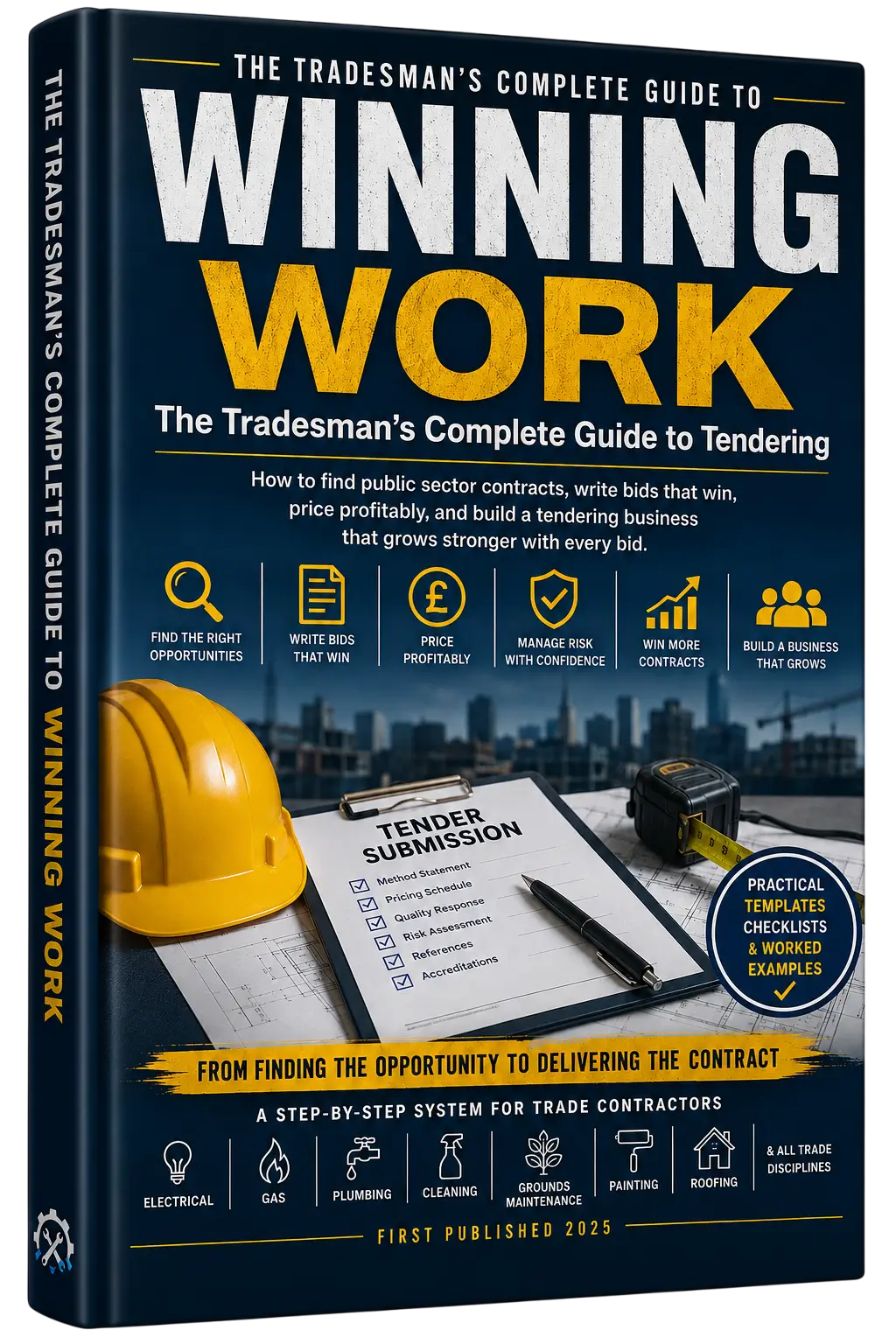
Want to improve your tender readiness? Winning Work — The Tradesman’s Complete Guide to Tendering takes you through prequalification, policies, RAMS, forms and tender preparation step by step. Its free downloadable toolkit includes business forms, records and registers, method statement templates, policy documents and a Commercial Contractor Pack.
Our free Risk Assessment, Method Statement and Toolbox Talk AI Prompt Builders can also help you build the health and safety evidence buyers ask for.