
BLOG
Should You Buy a Franchise?
What I Learned the Expensive Way and What Every Buyer Should Check Before Signing
Introduction
This article, like the book it draws on, is written for the UK scenario but the principles apply in most English-speaking nations.
Around ten years ago, I handed over a franchise fee, bought a van, and stood proudly under a branded gazebo in a supermarket car park, ready to repair windscreen chips for a living. I had done my research or so I believed. I had met the directors, spoken to existing franchisees, and even had a lawyer to review the franchise agreement.
The lawyer told me not to sign it.
I signed it anyway.
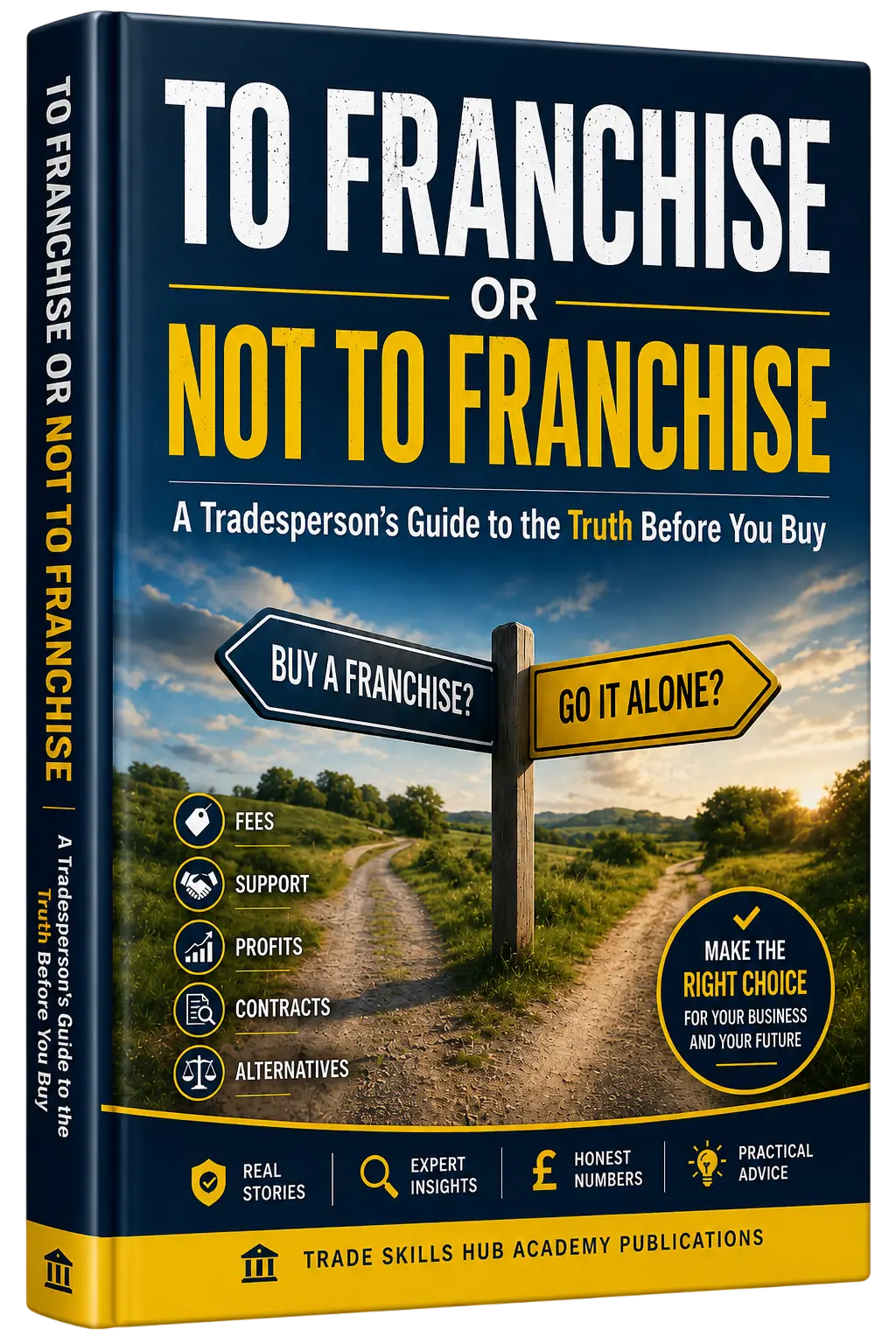
What happened next cost me my fee, my months, and a fair slice of my pride and it taught me more about buying a franchise than any brochure ever could. I have now put all of it into a book, To Franchise or Not to Franchise: A Tradesperson’s Guide to the Truth Before You Buy. This article shares some of its hardest-won lessons, because if you are currently looking at a franchise prospectus for window cleaning, oven cleaning, drain clearance, gardening, valeting, property maintenance or any other van-based trade there are things you deserve to know before your pen gets anywhere near a contract. If you’re also considering building your own business instead, our starting your own trade guides explain what it really takes before you commit to any model.
The dream is the product
Let’s be honest about why franchises appeal. You want to be your own boss. You want out of the office, off the tools of someone else’s business, away from the corporate nonsense. A franchise looks like the perfect bridge: an established brand, a proven system, full training, and a glossy earnings figure with “up to” printed in front of it.
I wanted exactly that. I had come home from a well-paid but high-pressure job overseas, determined never to work for anyone else again, looking for a simple outdoor business. Franchise marketing is engineered to land on people in precisely that frame of mind because it does not really sell windscreen repair or oven cleaning. It sells the life you have already imagined, and then attaches a fee to it.
That is not a scandal; it is just selling. But it means the excitement you feel reading the brochure is not evidence about the business. The evidence has to be dug out and the sales process is not designed to help you dig. Many people compare franchise opportunities with business start guides to understand what they could achieve independently.
A £15,000 franchise is not a £15,000 decision
Here is the sum that never appears at a discovery day. Take a typical van-based service franchise: a £15,000 franchise fee, a five-year term, fixed monthly fees.
By the time you have added the van, the equipment, the signage, the initial stock and the professional advice, your realistic cost of entry is around £34,000. Add the annual running costs royalties, marketing levy, insurance, fuel, stock, vehicle upkeep and the business must generate roughly £16,000 a year before you earn a single pound. Factor in borrowing costs and a sensible working capital reserve, and the five-year commitment comes to around £130,000, funded entirely by the work of one person with one van.
That is not an argument that every franchise is bad. A good business in a good territory can carry those numbers. It is simply the figure the decision should be made on and it appears in no brochure I have ever seen. In my book, Chapter 8 shows you how to build this calculation for any franchise, and Chapter 9 runs it through three honest scenarios: best case, typical case, and the poor performer. The gap between those outcomes is where franchise dreams are made and lost.
The territory decides more than you do
Here is the lesson I paid the most for. In my franchise network, at the very time I was struggling in the East Midlands, other franchisees in other parts of the country were genuinely happy with their businesses. Same franchise. Same training. Same equipment. Same effort. Completely different results.
One of the men I trained with had a territory on the south coast a comfortable part of the world by any measure and he fared even worse than I did, quitting within six months. General prosperity was not the variable. What decided our territories was the mechanics of the model within them: in our case, which insurers local motorists actually held policies with, and what happened at the gazebo when a service advertised as “free” turned out not to be free for most customers.
So when you research a franchise territory, do not research the postcode averages. Research the mechanism. Where exactly will customers come from? Who pays, and how often does that payer appear in your area? What does the travel geography do to your working day? And if the territory had a previous franchisee why did they leave?
One question reveals almost everything
If you only take one thing from this article, take this question, and ask it early:
“How many franchisees have joined the network in the last five years and how many have left?”
People do not walk away from businesses that are feeding their families. A network’s churn rate tells you more than any brochure, any testimonial, and any discovery day presentation. My own training intake was three new franchisees; within months, all three of us were gone. Any prospective buyer who had asked that question a year later would have learned everything they needed to know.
Follow it with a second demand: the full list of current and former franchisees, so you can choose who to speak to yourself. Franchisor-selected referees are testimonials with extra steps I learned this personally when one of the reassuring franchisees I had been steered towards turned out to be delivering my training course. Former franchisees are the most valuable interviews you will ever conduct. They have no relationship left to protect and no reason to varnish anything.
And if the franchisor refuses to share the churn figures or the list? Treat the refusal as an answer. A sound franchisor can answer every hard question without flinching. The numbers exist. The lists exist. Silence is data.
Read the agreement backwards
The franchise agreement is not the paperwork that records the deal it is the deal. Buried in almost every one is an “entire agreement” clause, which quietly means that verbal promises and glossy projections are designed not to count. If it matters to you and it is not in the document, assume it does not exist.
When you read the agreement and before your solicitor does start at the ending: the termination clauses, the early-exit damages, the restrictive covenants, the resale terms. Ask what leaving costs, what survives the business, and whether the customer base you spend five years building leaves with you or stays behind a covenant. I read those clauses properly only when I needed them, which is the one time they cannot help you. My exit was only achieved by raising the prospect of a complaint to the British Franchise Association. Do not plan on being that fortunate.
And one rule I am uniquely qualified to give: when you pay for independent legal advice, follow it. Advice you have decided in advance to overrule is just an expensive way of postponing a mistake.
The comparison nobody offers you
Here is the most clarifying exercise in the whole subject, and no franchisor will ever suggest it: price the same business without the franchise.
For that typical van-based example, starting independently costs around £18,000 to enter instead of £34,000, and roughly £10,000 a year to run instead of £16,000 even after spending more on your own marketing. Over a five-year term, the difference exceeds £40,000. In many trades, that is the difference between earning below a living wage and comfortably above one, doing identical work in an identical area.
What does the franchise fee buy that you would have to replace? Training, a system, a brand, and reassurance. For trades with real barriers expensive specialist equipment, regulated qualifications, emergency branding a franchise can genuinely earn its keep, and my book is honest about where and when it does. But for the accessible van-based trades, the knowledge a franchise sells for five figures can be bought for the price of a few good books and a short course. For example, this handyman business guide explains how many people launch successfully without paying franchise fees. That is precisely the gap the Trade Skills Hub Academy start-up guides exist to fill practical, plain-English manuals for setting up and running your own window cleaning, pressure washing, carpet cleaning, gardening, valeting, property maintenance or gutter cleaning business, on your own terms, with nobody to pay on the first of the month.
A franchise should win a comparison, not a coronation. If it still wins after you have priced the alternative honestly, buy it with confidence. If it only wins when nothing runs against it, you have your answer.
To franchise or not to franchise?
The honest answer is: it depends and now you know some of what it depends on. The trade. The territory’s mechanics. The contract’s endings. The real numbers, run through honest scenarios. And you: whether a system and a support line are genuinely worth the premium to you, or whether the van and the willingness to work were the business all along. If you’re leaning towards independence, these trade startup resources can help you compare both paths with confidence.
To Franchise or Not to Franchise: A Tradesperson’s Guide to the Truth Before You Buy covers all of it: how franchises are sold, the questions every buyer must ask, franchise agreements in plain English, the red flags, the true costs, real success and failure stories including the full account of my own and ten rules to apply before signing anything. It even includes a ready-made AI research assistant prompt to help you organise your due diligence.
It costs the price of a paperback. My education cost considerably more. One instruction runs through every chapter, and it is the best place to leave you:
Ask difficult questions. Do exhaustive research. And never, ever let enthusiasm override caution.